Sunday, August 15, 2010

Gourd to Death


The gourds continue their almost foot a day growth and massive production. Behind this tree of gourds, the vines have started their crawl over lawns and bushes.

This is another batch growing over the bird feeders.

This is one example of the pretty little decorative gourds.

I may have to set up a roadside stand to get rid of all these. Something like, I'll give you five free gourds for the price of one...

______________________

Hummer fans: Starved Rock State Park, Utica IL, is a gem for nature lovers. The beautiful 13 miles of hiking trails, rock formations, water falls, 18 canyons, boating, fishing, camping, horseback riding, and nature in it's Illinois abundance. Did you know that Starved Rock has been voted one of the "Top Ten Places for Fall Color in the Midwest"?


Starved Rock Hummingbird Workshop
Location: Visitors Center
Time: Sunday, August 22, 2010 at 11:00 AM
See the Hummingbird Garden at the Starved Rock State Park Visitor Center and enjoy seeing these amazing birds as they hover before your eyes!
Banding of live birds will take place at 11 a.m.
The Ruby Throat organization has loads of information regarding hummingbird banding. Quite an interesting topic. If you have next Sunday free, consider this Starved Rock experience.

Thursday, August 12, 2010

Hottie

In today's world, "Hottie" is someone who is really sexy or popular. For me today, it means weather!

Good grief - how do I forget late summer is so hot and humid? I guess the same way I forget February is so cold and gray. The four seasons is why many of us continue to stay and enjoy the Midwest. It's those little in between seasonal bumps that we forget.

Sneeze! And Sneeze again! I only went outside in my gardens for a few minutes and here I am with an "Awchooooooo" and a paper towel.

Tomorrow is suppose to be the warmest day of the year, possibly a record breaker. We don't have a "Heat advisory" - they bumped it up to an "Excessive Heat Warning" through Friday evening.

To digress a little: I remember (am I my grandma) not so many years ago on the farm when we never even heard of air conditioning. Frankly, it's true you don't miss what you never had.

So here's the scoop on the weather until this weekend from WQAD Anthony Peoples "weather or not" blog: "It’s going to be another hot one today and tomorrow, with near record or record high temperatures Friday."
"An “Excessive Heat Warning” remains in effect through 7 p.m. Friday for the Illinois counties of Hancock, Henderson, Henry, McDonough, Mercer, Rock Island, and Warren.
An “Excessive Heat Warning” runs through 8 p.m. Friday for Knox and Stark counties in Illinois.
High temperatures today will be in the low-to-mid-90s, but the humidity will make it feel more like 105-110.
On Friday, the highs will reach the mid-to-upper-90s and the heat index will be around 110 degrees for several hours.
An approaching cold front will bring strong to severe thunderstorms Friday evening into Friday night. Along with heavy downpours, damaging winds and large hail are also possible.
Showers could linger into early Saturday and then cooler and drier weather arrives Saturday night into much of next week."

I don't recommend working in the garden in this weather. A little run out in the early morning to pick a few tomatoes, herbs or check out something but take that Excessive Heat Warning seriously.

Keep hydrated and try to stay in the AC or with fans or both. Pollen counts for this area today are almost 7 out of ten and Sunday should be 9.4. Check on those who have no AC, are disabled, elderly, or have other issues that might be affected by this weather.

Really: the yard does not need to be mowed and the weeds do not need to be pulled until that cold front enters Saturday. AAAAchoooooooo!

It's the perfect time to sit with a glass of tea, in the AC, and read that new catalog... It's a know fact, day dreaming is a way to keep cool.

Tuesday, August 10, 2010

Bulbs Baby Bulbs

As you are resting this Fall season, it's a good time to think about planting Spring flowering bulbs. We often just think of tulips and daffodils but there are perhaps hundreds of other bulbs that can enhance your gardens.

When it comes to Spring flowering bulbs, size does matter. The larger the bulb, the better the chances of a large healthy flower, sturdy stem, and plant. It may also mean you will have a better survival rate over the years.

Tulips are not a "forever" plant. They will be healthy and abundant for several years and then they begin to die out. It's why I recommend planting a few bulbs every Fall.

Daffodils on the other hand, tend to multiply and have no real pests. They are considered deer resistant. They may last generations with minimal care.

Most Spring flowering bulbs need sunlight during their bloom season. This makes it easier to plant under trees and bushes that loose their leaves in the winter. They need sunlight on their leaves to garner nutrients for next year's flowers.

Never cut back the leaves of spring flowering bulbs until they have turned yellow/brown and are laying flat on the ground. Do not tie them in a bunch or trim. The only thing this accomplishes is to shorten the bulb life and reduce your display forever.

This is the reason to plant them among perennials since the emerging leaves will eventually hide the messy bulb leaves about the time they no longer need the nutrients supplied by sun.

The beautiful beds planted exclusively with tulips that may be seen in display gardens are typically dug up when bloom time has finished and stored in a cold house until they are replanted next year. This is hugely labor intensive and the reason most gardeners plant bulbs where they will remain for their life.

To fertilizer or not is debatable among gardeners. Some swear by bone meal when they are planted but if you have dogs, chances are they will dig them up to get to the smell. An all purpose bulb fertilizer each Spring is enough if you feel you must do something.

If you have rodents that eat your bulbs, plant in wire cages filled with soil. Use nothing too fine as it prevents the shoots from penetrating the wire.

If planted in a well drained spot, with Spring sun, they will usually do well. If your soil is heavy wet clay in the winter & spring, amend with compost. Soggy water-logged soil will rot the bulbs.

If you plant crocus or other small bulbs in the grass, it can be a beautiful display BUT it can not be mowed until the foliage dies back for the same reasons I've listed above.

When you see fields of blue grape hyacinths, daffodils or others, we are in awe and want that look for our own expanses. These fields are either not mowed until the foliage dies (pictures of this state are typically not in the catalogs) or there are two zillion gardeners doing the mega task of lifting and storing and replanting. I'm not criticizing these beautiful catalog and display gardens, I'm just saying it's not without it's own issues.

Some Spring flowering bulbs are more delicate than others and some are really not all that hardy in our Zone 5. Be sure and do your research before buying a bag full.

A few facts:

  • There are no pink colors on daffodils or jonquils. The picture in the catalog may be pink, in your garden it will be peach.
  • There are no blue tulips only shades of purple and lavender.
  • Double or ruffled daffodils and peony tulips may not attract beneficial insects because they can't get to the nectar. If you love these, consider planting both variety.
  • Parrot tulips are actually infected bulbs but that process causes no problem in your garden, it is used as a breeding device.
  • Check the size of the flower and length of the stem when selecting plant locations.
  • Always plant in bunches for the most visual show. I usually dig a good sized hole (exactly the depth stated on the packaging) and plant several at a time.
  • Stand inside and notice where a few Spring flowers could be viewed from inside the house (cause some Springs are too ugly to get outside much).
  • There are several devices for making bulb planting easier (not much but still...): attachments for the electric drill, small curved spades, etc. Unless I'm planting in the grass, I still use my big hole method for the fastest results. Always make sure you plant at the right depth.

I find planting Spring flowering bulbs the height of tedious. It's usually nasty weather, it takes loads of digging and bending and I'm totally out of the mood for any kind of gardening. BUT THEN: When spring comes I've ever so grateful for having stuck it out last Fall.

Whether you order on line, from a mailed catalog, a local nursery or a big box store, consider planting a few Spring flowering bulbs this year - the reward next Spring will be worth your effort.


“I have long been a Lunatic on Bulbs,

though screened by my friends,

as Lunacy on any theme is better undivulged.”

Emily Dickinson (1883)

Wednesday, August 4, 2010

Miss Marple's Mystery


“Miss Marple bent down on the terrace outside the French window and delt with some insidious bindweed. It was only a minor victory, since beneath the surface the bindweed remained in possession as always.” -Miss Jane Marple (Agatha Christy’s “Sleeping Murder”)

Field bindweed, Convolvulus arvensis, is a native of Eurasia and was first documented in the US (California) in 1884. By the first quarter of the twentieth century, field bindweed was proclaimed the worst weed in California and many of the western states. Field bindweed has been given many names including perennial morning glory, creeping jenny, bellbine, sheep-bine, and corn-bind. And a few that I won't mention used by gardeners weeding a patch.


The root system has both deep vertical and shallow horizontal lateral roots. The vertical roots can reach depths of 20 feet or more. When it travels on the ground it will send roots and stems out forming a new plant.


A hardy perennial, it spreads from the extensive rootstock as well as from seed. An average plant produces over 550 seeds. Sixty year old seeds have been shown to germinate.

Control of field bindweed is not easy, and it cannot be accomplished with a single treatment or in a single season. Effective control requires prevention of seed production, reduction of stored carbohydrates by deep tillage of the root system, competition for light from other plants, and constant vigilance in removing top growth. Pulling before it reaches over 6 inches in height is prudent but only one step.


The principal pollinator is the hawk moth. There are several herbal uses but from what I've read, I'd steer clear of all of them.


It will vine over bushes and ornamentals until it crushes or shades them to death. The best time to use Roundup is in the fall when the plant is storing up nutrients. At that time, Roundup goes to the roots. It is one of the first plants to sprout in the spring so a larger area could be sprayed.

If it is growing among/on evergreens or perhaps tomatoes, find where the vine emerges from the ground and break it, leaving it to die on the plant. Than, as it emerges from the ground again, paint Roundup on it with a brush/sponge.


Note: Garden variety Roundup is a contact hericide and must touch the leaves/flowers to be absorbed and go to the roots. It does no good to spray an area of ground if it doesn't touch the leaves. Caution should be used when spraying as it kills ALL plants sprayed.


Eventually, denying the plant/flowers (IE: seeds), sun and nutrients, plus herbicide use will kill that plant. Once infested, it is almost impossible to totally rid your yard of the vine. Especially if a neighbor's yard or field has an infestation. Do not compost vines or flowers.


A farm field heavily infested with bindweed will generally get less dollars per acre at sale.


Miss Marple knew her bindweed and the very mention in an old story - in another country lets us know how durable this insidious weed has been and still is. As expert, Sam Montana, said, "Good luck in your efforts to rid your yard of bindweed and may the force be with you."

Tuesday, August 3, 2010

The Gold Standard

Wouldn't it be great to have gold at a fraction of the current market value? Well, garden friend you can!

Marigolds are an annual that have everything to offer: colors, sizes, petal shapes, inexpensive in seeds or sets, and you can save the seeds for next year.

Marigolds were first discovered by the Portuguese in Central America in the 16th century. In India, they are prized for ceremonies and perfume. It's gold color is said to represent honorable people. (Discovered doesn't mean they weren't around before that date, it means it's the first recorded date.)

Translated, Marigold means Mary's gold. Called this because they are said to be the Virgin Mary's flowers. It is also a poor man's saffron. It's had many medicinal, herbal, and superstitious meanings.

The average height of calendula marigold is 12-24 inches tall. The leaves are a rich green and spread to a width of 12-18 inches. Flowers come in singles, doubles and semi-doubles. The colors range from white through gold, yellow, and orange. The blossom can be up to 4 inches wide. They do not have as pungent of a smell and are better for picking.

The height of tagetes marigolds can range from 12 inches up 36 inches. The leaves are serrated and dark green. Their flowers are available in white through gold, yellow, and orange with fabulous combinations of shadings, picotee, and spots available. Tagetes are available in single and double sizes and the blossoms of the largest can reach nearly six inches. They are toxic for human consumption but do have insect pest deterring properties. They smell really bad.

Both calendula and tagetes varieties of marigolds are easy to grow. They require full sun and well-drained soil. Calendula can tolerate poorer quality soil than tagetes.

There's a whole lot of interesting history and uses for marigolds outside of what I've written. The bottom line: If you like bright colors, easy maintenance and low cost, marigolds are for you.

Whether planted around your vegetable garden, in a formal bed, in pots, or a cottage garden, marigolds are for you.

If you want to plant something that requires very little follow-up, watering, and fertilizer marigolds are for you.

If your garden has dark colors, little contrast, bare spots, or zero fall color, marigolds are for you.

Described as vulgar by some and a must have by others: I'm with the golden last.

Final Note: The Pekin IL Marigold Festival is September 10-12, 2010. 309-353-3100 for details

Monday, August 2, 2010

Not That Garden!

Talking to a fellow last week who said he gardens. I was rather surprised at this florid-faced well over 300 lbs. man, but, he insisted he gardens most Saturday evenings. Huh - evenings??? With a hardy laugh, he told me he "Beer Gardens".

There are many kinds of gardens and gardeners and I enjoy learning about what makes it their passion and something about their products.

One type of garden, or better termed farm, is vineyards. Grape growing has become a micro industry in Illinois in the last several years. More and more, wineries are springing up and doing well.

Vineyards are not for those who want instant gratification. It takes money (doesn't everything) and time to grow just the right grapes for our climate and soil. Most grow for others - selling to places that have their own processing plants.

Conner's Kickapoo Creek Winery (Address: 6605 North Smith Road, Edwards, Illinois 61528 Phone: 309-495-9463 http://www.kickapoocreekwinery.com) has both. When Dr. Dave Conner turned his farmland into a vineyard, it was the beginning of a nice combination of businesses. Their tours and other features are fun - along with the wine.

We often read about micro (beer) breweries but Illinois is marketing "Wine Country" and I wish them well. http://www.illinoiswine.com/ says there are over 90 wineries and over 450 vineyards in Illinois. Some of them (in addition to Kickapoo) close to this area:

  • Indian Creek Vineyard, Toulon IL
  • Wilitt's Winery and Cellar, Mantino, IL
  • Mackinaw Valley Vineyard, Mackinaw IL
  • August Hill Winery and the Illinois River Winery, Utica IL
  • Lavender Crest Winery, Colona IL
Wine growing in vineyards has it's own set of growing rules, but, in the end, it's farming. Something (farming) that's near and dear to Illinois rural America.

If you enjoy a glass of wine now and again, or just like taking a drive to enjoy the scenery, stop by your local winery.

As I've mentioned before and pictured above, my blue bottle tree (some call it by less than flattering descriptions) has inspired a couple of friends to donate bottles. One friend tells me she only drinks wine to help supply the blue bottles for my tree. That and a good beer garden are our laughs of the week.

Sunday, August 1, 2010

Magic Two-Hundred

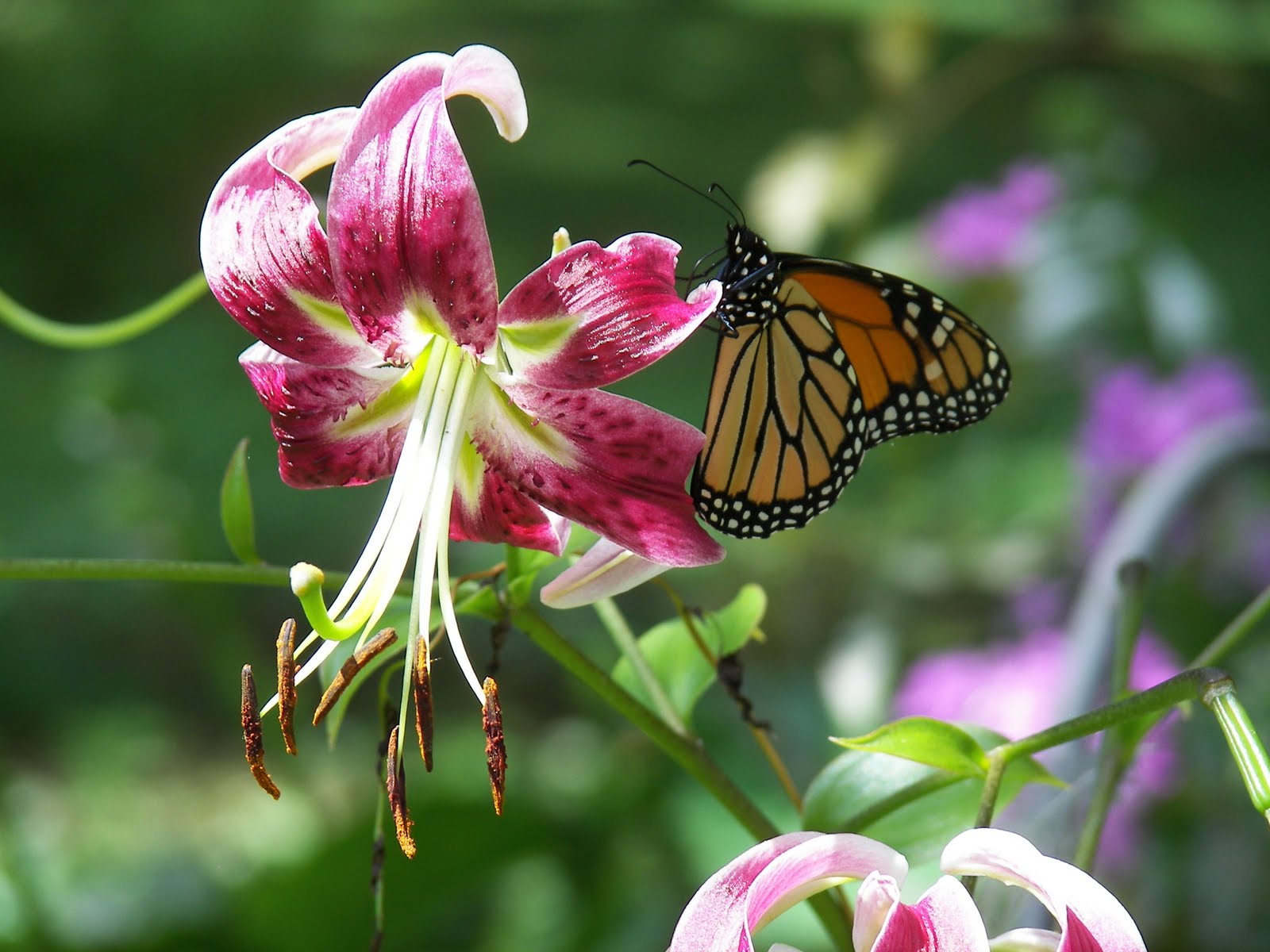
Photo of a Monarch butterfly taken yesterday on my Tiger Lilies

Referencing the Magic Two-Hundred: As our friend, Bud McKirgan, says in his Prairie Shopper editorials, "I'll get back to that in a moment."

Today is August 1st and it typically marks a turning point towards Fall in the Midwest. I really didn't want to turn that point this year. I wanted to hang on to my daylilies, the milder weather, and summer optimism.

Even the birds know it's "that time of the year": Purple martins, sora rail, osprey, shorebirds, hummingbirds and warblers will start their migrations this month. It's a good time to get hummingbird feeders in place for high energy snacks as they migrate.

It's a great time to sit on the porch (and I'm thankful for screenwire) and watch and listen to the sights and sounds of the fall days. Cicadas have started their calls, crickets are busy, birds are talking and getting their young ready for leaving the nest.

We have a pair of wrens nesting in the front porch fan housing. They started in a little decorative birdhouse I'd hung in the honeysuckle that drapes the front railing. When it became the major interest of our cat, they moved to higher ground. Needless to say we've missed using the fan this summer but it appears they are continuously feeding young so it should be soon vacant. Faithful husband will then dismantle the fan, clean it and bird proof the top.

Wrens are fun to watch. The male takes part in the feeding,is the watch alarm and directs the traffic flow. The female stabs an insect and takes it to the nest. The male has a particular song that says, "I have a bug and the coast is clear for mother to exit the nest." They keep up this swap all day long.

The wrens aren't bothered by humans on the porch swing or dogs napping on the floor. If the cat comes within twenty feet, the male starts a cackling noise which must be an alarm.

You may also notice stray feathers in your yard because it's time for many birds to molt. Robins have begun this process and I've noticed several blue jay feathers and some fluffy whites.

Always a rebel, the goldfinches are just now nesting. They will soon have eggs to hatch. Many don't realize goldfinches are year round residents of this area. Later in the year, the male molts to it's winter green color - loosing the beautiful gold feathers.

Back to the magic two-hundred. It's probably more "magical" to me than any other. This article is the two-hundredth of this "For the Love of Gardening" blog. Not read by the thousands as Julie in the "Julia (Childs) and Julie" fame but it's been fun for me to share and talk about garden things I enjoy.

I've often said a writer is a person who enjoys conversation, just not with people. That's a joke, mostly and sort of because I do enjoy some really good "in person" friends. Till next time. . . keep your stick on the ice (Oh no can't use that it belongs to Red Green). Keep your hand on a glass of lemonade and your head on the hammock.