Wednesday, June 30, 2010

Random Musings

A daylily (and other things) flower bed going crazy.

A Monarch Butterfly sampling the nectar from the hosta flowers.
This week in central Illinois has been a gardener's gift: No rain or storms, mild summer days, little wind, sun and cotton clouds - it's what we all want all summer long. Yes, I know we can focus on the insects and weeds but why waste this beautiful week being negative?
If you don't have your own beautiful yard or flowers, take a walk or drive and borrow the pleasure from neighbors. Even a roadside wildflower makes a beautiful bouquet.
~+~
Gardening is the art that uses flowers and plants as paint, and the soil and sky as canvas.”
~ Elizabeth Murray
~+~
A side note: The Galva Arts Council's 4th of July photo show/contest will be this weekend. Check out the local paper or the GAC website for details. There are always beautiful pictures, many featuring things in nature.

Saturday, June 26, 2010

Lazy, Hazy, Crazy Days of Summer

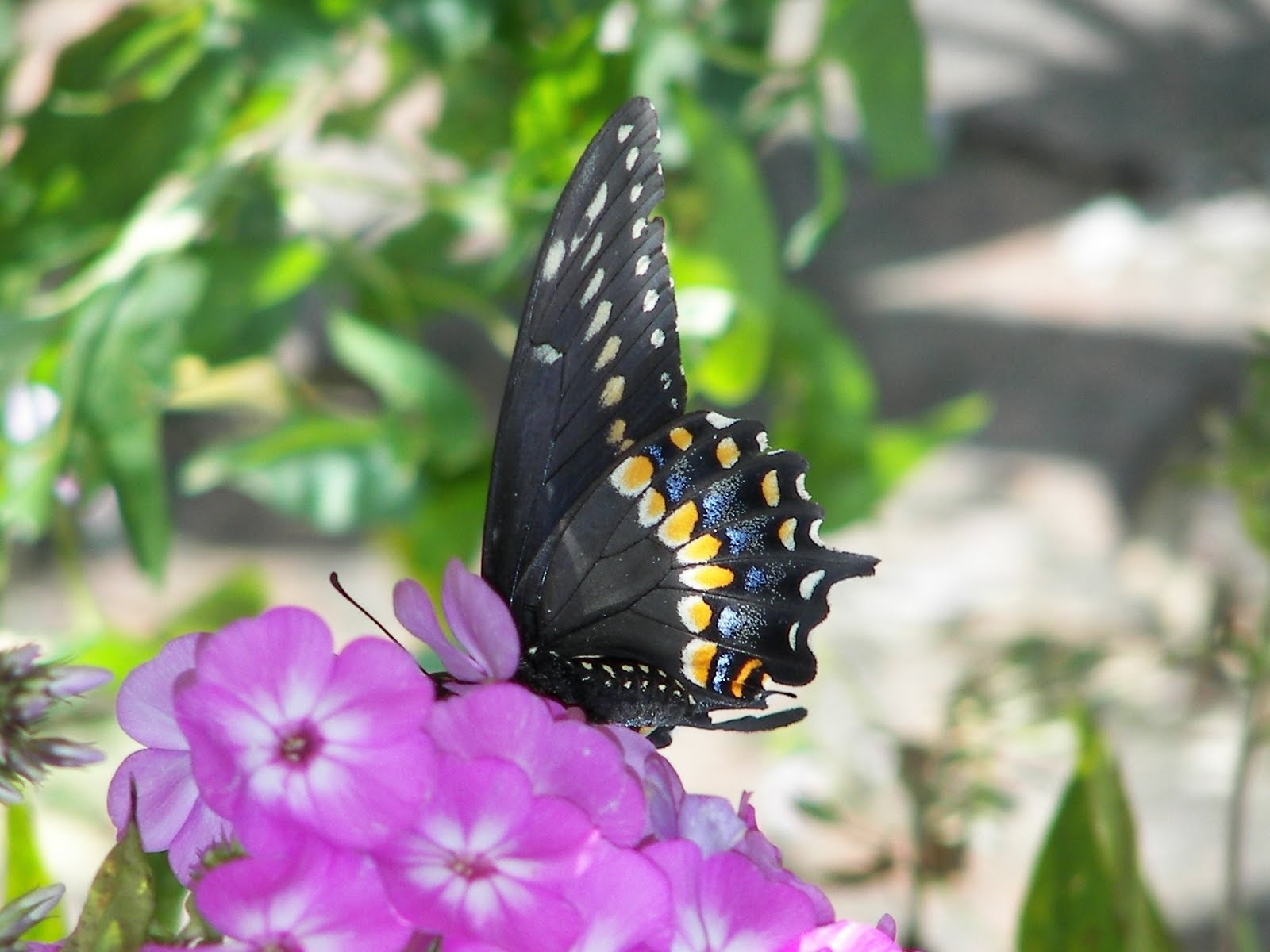
This is a Eastern Black Swallowtail (Papilio polyxenes) on a sage leaf. In the past, they have been on my Queen Anne lace, parsley and rue. This year they were on my dill. I never mind offering up some of my herbs to caterpillars because the end result is a beautiful butterfly. If one can get over the "wormy" issue, this caterpillar is quite beautiful, too.


The next two photos were taken in the fall and the favorite food choices were phlox and bee balm.


Some people find phlox too informal for their gardens but I let them self seed with abandon. Among the last flowers to bloom, they offer nourishment in the form of nectar for butterflies. That and the fact they are beautiful in their array of pinks, whites, and lavenders.


Often the most desirable food for butterflies are the native and more casual looking plants such as bee balm (pictured above.) Each little point is a source of nectar. As the plant dries in the fall, butterflies still eat again and again from the remaining parts.
As I've said at least a blue zillion times, if you want beautiful butterflies, you must have host plants for the eggs, caterpillar, chrysalis and the butterfly. AND, not use insecticides - butterflies are very sensitive to insecticides.
The Eastern Black Swallowtail is common in this area. Right now is the time when I first see them flying - the caterpillar was easy to photograph a few weeks ago as it lazily munched dill.
I've never been very good or very attentive to finding the yellow eggs or brown wood like chrysalis.
The 1963 hit song by Nat King Cole, whose lyrics go, "Those lazy, hazy, crazy days of summer - those days of soda and pretzels and beer" came to mind as I watched a butterfly floating from flower to flower and then flutter over the house.
I've seen more butterflies this year and the season is just getting started. While mowing this week (between rains), the roadside was simply shimmering with so many different butterflies. I'm thinking it has to be attributed, in part, to the lack of roadside mowing. Yes, our poor Illinois fiscal situation is actually benefiting at least the insects of our state.
Now everybody join me - a one and a two...


"Roll out those lazy, hazy, crazy days of summer

Those days of soda and pretzels and beer

Roll out those lazy, hazy, crazy days of summer

Dust off the sun and moon and sing a song of cheer.

You'll wish that summer could always be here.

You'll wish that summer could always be here."


OH YEAHhhhhh!

Wednesday, June 23, 2010

What to Do?

A picture of Designer Gown daylily after a heavy rainstorm.
Incoming storm.

Daylilies to be enjoyed even when it storms.


What do you do when there's a (1) severe thunderstorm warning (2) flash flood warning (up to 5 inches) and a (3) heat advisory? Pick daylilies before it storms and enjoy a day's worth of perfect blooms!
Because storms are predicted all day, I wouldn't be able to enjoy them blooming in the garden. I can now walk by this table, on our porch, during the day and enjoy the looks, the fragrance and throw away right after dark settles over us. Nothing lost - much gained.

Thorns and Sweetness

This picture of Blackberry Jam and recipe are from http://www.pauladean.com/

Blackberries are producing like crazy this year thanks to all the rain and humidity. I have to be really fast to beat the birds to the day's bounty.

I transplanted a few blackberry bushes to this home in 1997 and I'll never be without them again (both by choice and thanks to birds).

I had planted them under windows as they did in Victorian times. They were used as prowler deterrents. Little did I know they were also house painters, husband weed-eater guy, and running children deterrents. By the time I could admit to my error, they had been seeded throughout the property and I was able let them go close to the house.

Blackberries and raspberries are much easier for me to grow than blueberries because of the walnut trees. Although my blackberries are from some long lost strain (more wild than hybrid) they suit my taste just fine.

Blackberries aren't easy for a small property because of the spreading by birds and every branch that hits the ground roots. They spread quite readily and pruning is a fight with thorns every time. I'm a lackadaisical pruner so mine thrive in spite of my efforts.

Some of the new hybrids have more controlled habits and the size of the berries are much larger. Flavors vary somewhat from tart to sweet and from seedy to meaty.

Here's Paula Deen's recipe for Blackberry Jam. Always good but I must admit I go outside in the morning - pick a cup of berries (what doesn't go directly in my mouth) and have them on my cereal. Good stuff.

Blackberry Jam
by Cooking with Paula Deen Magazine July/August 2010

Paula says the secret to the tastiest canning boils down to one simple rule her Grandmother Paul taught her…use only produce just picked from the field.
Support your local farmers and your pocketbook this summer by buying your produce when it’s at the peak of freshness and coincidentally most affordable. Following Paula’s simple recipes and canning techniques will guarantee you some of your own “Summer in a Jar” come December.

Blackberry Jam Yields: 6 (½ pint) jars

Ingredients:
5 cups blackberries, washed and drained
1 tablespoon lemon juice
7 cups sugar
1 (1.75 ounce) package dry pectin6 (1/2 pint)
Canning Jars with lids

Directions:
In a large saucepan over high heat add blackberries, sugar, and lemon juice. Stir frequently while bringing to a rolling boil.
Stir in pectin and continue boiling for 1 minute. Remove from heat and skim any foam from the top if necessary.
Sterilize jars and lids directly before using for 10 minutes in simmering water or in the dishwasher. Remove one at a time when ready to fill.
While blackberry mixture is still hot, ladle into the hot sterilized jars, filling to within 1/4 inch of the top. Wipe rims with a clean damp cloth and seal jars with lids and rings.
Process in a boiling water bath (making sure water level is 1 inch over the top of the jars) for 10 minutes. Remove from water bath and allow to cool on the counter.

Courtesy of Cooking With Paula Deen Magazine July/August 2010

Tuesday, June 22, 2010

Humor is good meds.

This was on the WQAD weather facebook page. So funny!

Monday, June 21, 2010

Freakin' At the Freaker's Ball

This is a picture of Stella de Oro daylily. A sloppy photo at best, but, I wanted to show (clockwise starting at the top): blooming flower, a bud not opened, a spent flower and a seed pod.

I've often been asked, "Is the only reason to deadhead daylilies to make the plant look better?" The answer to that is, "Yes, it does make the plant look better." And, "No, there is a more important reason for deadheading."

If a daylily is allowed to set seed heads, the plant will put energy into developing those seeds and preform as if it's the end of the blooming season. At the end of the season, a plant will not concentrate on blooming. For an continuous bloomer like Stella, that will limit the new flowers and the length of the bloom season.

Even the non-continuous bloomers will put more energy into making fully developed flowers over an extended bloom period if they are deadheaded daily.

For the meticulous: carry a sack and slip the spent flowers inside. For the rest of us: simply toss on the ground and know they will go to mush in a few days.

Another reason for deadheading every morning: Photographs will never have a glob of dead flower to spoil the look.

____Freakin' at the Freaker's Ball____
I have no idea where I got that phrase but I immediately thought of my crazy daylily madness. Must be my latent heavy metal past catching up with me in the garden.
_____Peak Daylily Shows_____
Our early spring and heavy rains have contributed to an early bloom season - daylies and others. Commercial nurseries are no exception. Hornbaker Gardens' newsletter says their daylily fields will be at peak starting around June 25 and some varieties will start the end of July.
Here's a break for those who live around professional daylily gardens: It is much better to see the daylilies growing up close and personal than in a catalog. Seeing a group of daylily freakers in a daylily field is surely a daylily freaker's ball.
And if you see multitudes of daylily freaks freakin' at the freaker's ball, try to ignore us - we're harmless and you just might become one...

Saturday, June 19, 2010

Head - Heart - Hands - Health

"I pledge my Head to clearer thinking,
My Heart to Greater loyalty,
My Hands to larger service,
My Health to better living -
For my club, my community, my country and my world."

The 4-H pledge says a lot about the members, how they live their lives and the projects they bring to the 4-H Fair each year.


I am privileged to again be a judge in the Horticulture and Floriculture divisions. It's an enriching experience. It brings hope for the future generation and pride in the many young people who want to learn and work.

The above picture was a Floriculture "D" entry. Her theme was the "4th of July" and she not only met the criteria for this category but did it superbly. You're looking at a blue ribbon winner.

I was expecting a poor turnout and poor quality of plants and vegetables this year because of the weather and how early our fair is held. It was the opposite - more kids and a surprisingly high quality of produce.

As might be expected, a good percentage of those participating in horticultural projects are from farm families but we have a good share of members who garden at grandma's house, in a small patch beside a city house, a greenhouse and even in disposable cups on the window ledge of the subsidized housing project. And, they all do it with enthusiasm.

Considering we had a huge storm last night (high winds, over two inches of rain in less than a half hour, hail) it was amazing how clean and neat the vegetables were in displays. They all talked of the "trails" of our wet spring and what they had learned. Bless youth: they all laughed and did their best.

The excess rain has even given some vegetables an earlier maturity: Many varieties of lettuce, radishes, huge broccoli, cauliflower, wonderful onions, rhubarb, peas, small potatoes, beets, horseradish, and others. Flowers were the same way. Green, yellow and wax beans were the only thing I saw that was less than perfect.

Judging at this level is not based on the perfect vegetable or flower. It's not really based on perfect anything. This judging rewards effort and there is verbal and written feedback from the judge that is meant to teach and encourage.

I have done this long enough I get a chuckle out of how garden philosophy is typical with different backgrounds.

Farm boys old enough to help in the field think about gardening in the big picture and not so much the presentation. They raise vegetables much like field crops, IE: they must be good enough to eat and/or sell.

Horticulture students (to be) will know a boat load about how it all works. They enjoy engaging someone who likes to hear "the story" as much as they like to display.

Some youngster's focus will be developing a beautiful display. The variety will be the same size, visually orderly and labeled. Perhaps even a basket lined with a country napkin.

Some kids are totally into taste and can describe in detail the little nuances of flavor in each variety they exhibit.

Can you tell I'm impressed? In total, there was not one entry or it's owner that was a disappointment. They each had their individual strengths and their enthusiasm was contagious.

Their ability to look at the positives of their efforts and laugh off what nature throws at them is a lesson for everyone.

It was a great day! Spend some time this week at the Henry County Fair and visit the 4-H exhibits. Rural American is alive and well! And, I'm thankful!