Tuesday, July 8, 2014

Dad's Best White

If you've often read my blog, you know I'm crazy about daylilies.  I've spared you recently by not writing non stop about them and today I'll bring them back.  Let me wax on . . .

"Dad's Best White" is a daylily you'll want to get if you want E.V.E.R.Y.T.H.I.N.G.

I ordered DBW from Oakes Daylilies and it was a grand total of $9 - that's a bargain.  It was hybridized by Viette and registered in 1984.

The six inch flowers are a light yellow/cream with a small green eye.  They shimmer with a pearlized finish.  They're large enough to make an impact.  The petals are thin which makes them look like they are floating on the plant.

The scapes are considered self-branching - meaning they will have many opportunities for flowers.  They are about 28 inches tall so planting near the front of your garden bed gives them ample viewing.

They are considered a single flower (meaning no frilly petals in the middle), a diurnal and a diploid for those of you who are into the specifics.   They bloom mid-season.


What makes this an outstanding daylily is it is covered with flowers for approximately 45 days consistently every year no matter what the conditions.

The flowers aren't damaged by average summer sun, wind or rain.  They open cleanly and close tightly making it easy to deadhead.

I have no other daylily that is as consistent and as fully flowered as this variety.

The light cream color is a perfect foil for other bright daylilies or perennials.  It pulls the bed together through it's neutral color.  This doesn't mean it isn't a show stopper because it's mass of flowers draws attention.

The clump increases in size and it can easily be divided over and over.

Try some white daylilies in your garden.  So easy to care for and so beautiful.  I bought this one to add to my family garden in memory of my dad, Ward Shenk.  Since the chances of finding a daylily named "ward" was slim, I settled for Dad's Best White and I've not regretted it once in the five years it's been in my garden.

Side note:  The difference in color between pictures has to do with several things:  Time of day, cloudy or sunny, the year and where I'm standing in relationship to the light.


Saturday, July 5, 2014

Gardening for Scrap Metal

Metal Praying Mantis made with scrap iron
We have a new loosely formed garden group.  The rules are there can't be any rules except courtesy to whoever is initiating some fun thing to do.  And since we're all gardeners, courtesy is a way of life so there ya' go.

One of the group who (with her husband) owns the local metal scrap yard, invited us to a morning of scavenging or pickin' for garden objects.  When someone is pickin',  "garden object" is in the eye of the beholder and twice the fun.

We came prepared with heavy work shoes, gloves and old clothes.  It was a cool breezy day so insects weren't an issue.  It was perfect pickin' weather.

Honestly, if we'd had a crane and cutting torch we would have been dangerous.  In leu of those, we culled what we could carry.  In addition, a beautiful patch of wild flowers (perhaps "Purple Prairie Clover") was dug in hopes of transplanting. And our friend also brought each of us a start of Sedum "Neon".

So what did we find:

A heavy cast iron thing with a hollow center and flared on both ends.  About 3 ft. tall, it will become a table with the addition of millstone on top.

Various license plates and street signs to become roofs for bird houses.

Several old cast iron pieces from planters, pickers and hoes.

Bottle flower from rebar.
Rebar (a gardener can't too much rebar.)

Lots of pieces of things from who knows what that will be repurposed into signs and object of art.

What we might have got:

Large pieces of sheet metal that had beautiful unusual holes stamped in them - they would make fabulous trellis.

Metal wheels still attached to old farm equipment (the torch reason) could be a fence or art.

And then bins and stuff and such.

Yes, a day at the scrap yard is a day of gardening fun!


Wednesday, July 2, 2014

Who Me - Obsessive?


How to know if you might be a bit obsessive about gardening:

Baltimore Oriole 
You have more bird feeders than dinner plates.

You wash your garden knickknacks in the dishwasher.

You know who hybridized certain plants.

You can’t walk outside without bending to pull a weed.

Manicure means clipping your nails short.

You can spend as much time picking out a pair of garden clippers as most people spend picking out a good steak.

You’re a bee whisperer.

Daylily "Corryton Pink"
The first flower on your favorite plant makes you smile.

You’ve honestly thought about the dead plant grieving process.

You’ve moved a perennial more than twice.

You categorize garden friends in a special category.

You know the difference between beneficial and non-beneficial insects.

You forgive another gardener’s eccentricities because they’re gardeners.

A rainy day means the weeds pull out easier.

From the net - wish it was my garden!
You’re in awe of anyone who does bush sculpting or has topiary.

You stop your morning walk to stand a moment and enjoy someone’s gardens.

You describe where someone lives by the plants in their yard not house color.

You’ve been late to events because you walked outside and bent to pull just one weed.

You spend more on birdseed than your last meal out.

You consider what plants beneficial insects need at what stage in their life.

You’ve spent a considerable amount of time discussing the merits of certain sunscreens, insect repellants and fertilizers.

Socializing is talking gardening.

You gleefully forward a great article on gardening to a select few friends you KNOW will love it, too.

You consider the sky the backdrop for your garden.

You always reach for a specific set of clothes for gardening:  loose, offering sun protection and slightly stained.

Your garden hat is seldom pretty or becoming.

At a certain age, your hands, back, neck, or whatever doesn’t always work right because you have stooped, lifted and pulled in your garden for so many years.

You actually read plant labels.

You’ve researched a garden issue to the point of knowing more than most horticulture experts.

You’ve taken garden classes and you’ve given garden classes.

My gardening friend, Shelly, garden partying.  
You go to a garden party in comfortable shoes because you’re going to walk in the gardens.

A glass of iced tea or cup of coffee in the garden means you’ve learned how to bend over, pull a weed without spilling the drink.

You don’t take offense if another gardener reads a garden catalog while visiting.

You know the good, bad and ugly of every nursery within 200 miles. 

Each plant has a personality.

You have almost as many pictures of your plants as you do family.  If you have more you say it’s for research.

Tomato sauce - yum yum.
You know how to preserve food and use herbs.

You consider a gift from someone’s garden better than money.

You pretend summer time company isn’t about how your gardens look as a backdrop.

You don’t gossip about the shortcomings of another gardener’s mistakes, tasks not done or choices.

You have a rain gauge, outdoor thermometer, and most have a device that measures humidity, wind speed, and a host of weather data. 

You know as much about your favorite weatherman/woman as TMZ knows about celebrities.  You occasionally use his/her name in vain. 

Nasturtiums are good in salads.
You can recite how a certain plant has performed over the years related to the weather.

You’ve eaten a flower.  

Do any of the above make you an obsessive gardener?  Of course not, you’re just passionate!  Denial, it works for me.  


Monday, June 30, 2014

Rainy Day and Mondays

Thunder has been gently rolling around the dark skies for about an hour and the weather alert has periodically cried it's "significant" storm and flood warnings.

I went outside early to take pictures; right after over an inch of rain dumped on the gardens.  I thought I'd get the pictures of my daylilies done since thunderstorms are predicted for most of the day.  Alas, yes, alas:  The early morning bloomers were tattered and worn from the heavy winds/rain.  The late bloomers were holding tight because the sunlight wasn't to their liking.

What to do?  What to do?  Trying a new recipe seemed a good idea.

A new recipe popped up on Facebook:  Old Fashioned Oat Cakes from Rock Recipes (Barry C. Parsons) an on-line cooking blog.  This sounds terrible healthy and it does have some good ingredients, but, it's never going to be included in any healthy eating cookbook.  On the flip side, it's delicious.

Old Fashioned Oat Cakes

Preheat oven:  350 degrees - Makes 8-15 cakes (depending on size)

Sift together:

1 1/2 C - Flour
1/2 tsp. - Baking soda
1/2 tsp. - Cinnamon
1/2 tsp. - Ground nutmeg
1/4 C - Sugar
1/4 C - Brown sugar
Pinch - Salt

Rub in, cut in or pulse in a food processor:

3/4 C. - COLD butter - cubed 

Toss in:

1 1/2 C - Large rolled oats
Optional:  1 C - dried fruit -or- chopped nuts -or- chocolate chips

Add:

1/2 C - Undiluted evaporated milk (NOT condensed milk)

Toss together with a wooden spoon until soft dough forms.  Roll the dough on a lightly floured board to 1/2 inch thickness.  Cut with 3 inch biscuit cutter or form with hands.

Place on a parchment lined cookie sheet.  If the butter has become soft, put the cookie sheet/cookies into the freezer until the butter is again firm.  Bake at 350 degrees for 18-20 minutes.  

Mix:

1 1/2 C - sifted Confectioners Sugar
Evaporated Milk
2 T - Real Bakery orange flavoring

Add enough milk to make a thick syrup constancy.  Add flavoring and drizzle over warm cakes.

Cool completely on wire rack.  They will keep several days when stored in an airtight container.  

I take the blame for the optional items; I used dried cranberries.  I also added the icing.  I mean if you have that much butter in ten cakes, a little icing isn't going to make or break your diet.  

If you want healthier and less flavorful isn't an issue with you, experiment with:
Use a gluten free flour instead of wheat flour
Use frozen walnut oil instead of butter
Use molasses and/or honey instead of sugar (prob. needs less)
And forget the icing.
I haven't tried any of these because I'm OK with these little goodies being rich.  Old recipes for oat cakes use lard and cream instead of butter and evaporated milk.  They don't have additional "optional" items.  The old fashioned was basically something to go in a pocket or lunchbox.

Top photo belongs to Barry - bottom (and less pretty example) photo is mine. 

I liked the sweet and tart flavorings against the heavy oatmeal constancy.  Wrap in waxed paper and tie with a string to transport.  Don't allow them to absorb moisture or they fall apart. 

Today isn't so much about gardening as what to do when I can't.  Have a great and safe day.  


Thursday, June 19, 2014

Dealing With Winterkill


All right it’s the middle of June and some plants did not survive this past winter and others have been damaged; it’s called “winterkill”. 

Winterkill is often used to describe loss of field crops such as alfalfa, rye and winter wheat.  This year it’s being used to describe damage to bushes, trees and perennials in the Midwest.

Large amount to evergreens have turned rusty colored brown.  This was due to a combination of extreme cold being pushed by strong winter winds.  Calm cold usually doesn’t kill – it’s the wind that cinches the death and damage.  Combine that with two summers of drought conditions and it can be a deathblow.

Conifers and evergreens such as American Yew, arborvitae, pine, spruce, hemlock and others all have suffered noticeable damage.  The reason these are damaged more than deciduous trees (they loose their leaves) is they loose moisture through their “leaves” on sunny days.  When the ground is deeply frozen, they can’t take up more moisture to replace what’s lost.  Foundation evergreens will suffer more because they also get the hot reflection off the siding. Evergreens and conifers planted close to roads will often die on the street side because they have been hit with splashed or windblown salt spray.
Winterkill on holly bush.

Check the trunk of deciduous trees to make sure there was no rabbit damage.  They can girdle an entire trunk, which will kill a tree,  Deer damaged trees may survive if only branches and tips are ate. 

At this point, if your shrub or tree is completely brown, it’s probably not going to come back.  Try scratching the bark and if it’s green underneath, it may still be alive.  Alive may not actually mean you have a good-looking tree because evergreens do not typically send out new branches to replace lost.  They may start growing at the top and according to where it sits, that may be good enough.  I think it’s safe to say it will never look the same.  Also, a severely damaged tree will be susceptible to disease and insect damage over the next several years.

If your shrub or tree has only branches damaged, it’s safe to remove that branch if there are no sprouts showing.  Let nature cleanse your evergreens if only the tips or some needles show brown.  Remember:  white pines routinely have loss of needles and that particular loss isn’t deadly.  If they are putting on new candles, they are surviving. 

After you decide to remove a dead or severely damaged shrub or tree, check out varieties that are resistant to winter kill.  Don’t plant where they will be subject to long periods of warm winter afternoon sun or salt spray. 

Most experts don’t advocate anti-desiccant sprays because they are too labor intensive and seldom really work.  Wrapping a shrub in burlap may help as well as putting up windbreaks.  Don’t cover in material that will hold winter heat during the day as that will cause it to think it’s spring and the new growth will be. Killed.

(Middle) "Blue Hosta" stunted this year.

(Middle) Blue Hosta where it is healthy and thriving.
We’ve also seen some significant winterkill on hosta.  I lost some and others seem stunted.  Right next to this is a totally healthy and thriving hosta.  Experts can’t explain why or how this happened in this way.  I’m doing the “2014 wait and see”.  I’m not digging where there was once hosta and I’m hopeful there will be something in the ground waiting for next year to again reappear.

It’s a pretty good bet if your roses show no growth whatsoever, they are dead and should be removed.

Japanese maples, flowering dogwood and Japanese flowering cheery cultivars are usually only hardy to -20 degrees.  If your trees were saved, it’s because they were sitting in a microclimate.

On the other hand, some of my perennials, trees and bushes have never been more healthy or thriving.

Enjoy this beautiful June 2014 – it’s been a bonus after a tough winter. 

Thursday, June 5, 2014

Pooville


Part of the 4-H cattle experience is dealing with 
manure:  Cleaning beds,
cleaning it off the calf and occasionally off my shoes...
Have you considered going natural fertilizer for your garden and flowerbeds?  Natural fertilizer is manure or animal poo poo for the more delicate natured of my readers.

There are animal owners who give away or sell this animal by-product.  It may be harder to find if you live in urban areas but not impossible.  It’s also sold by the bag, cleaned and the stink removed. 

Some manure is called “garden stew” because it’s steeped in water and the resulting “tea” is used because that’s where all the nutrients remain.  It’s not hard to do this if you don’t mind the icky factor.

Manure from all mammals are not equal in nutrients or safe to use on all garden plants.   People poo:  not so healthy.  People pee:  good for non-edibles.  There’s a reason trees by guys events grow so tall . . .

I’ve used cow and horse manure with good results.  Plus, it has the benefit of not being so very smelly.  Although if you let it age a year, it has almost no smell at all.  Aging manure should be mixed with straw, dried leaves or wood shavings and turned every once in awhile.  Get this pile going and you’ll find earthworms having a field day.     
Rather than show stacks of manure, I'll just 
show layers  of things that love a well manured soil.

I took a survey of poo users and it varies widely so I’ll just list some of the benefits.

Chicken & turkey:  High in nitrogen means it is great for the garden but can’t be put directly on plants because it may burn the roots.  Mix the manure with carboniferous material (such as dead leaves) and the strong ammonia smell will be eliminated. 

Rabbit:  Although not as available, it’s high in nitrogen and phosphorus.  Almost odorless and breaks down easily. 

Horse:  Horse manure contains moderately high nitrogen although some gets used up by the bedding materials.  It also contains viable weed seeds because their digestive system does not break them down.

Cow, sheep, goats, deer & pig:  Weed seeds do not survive their digestive systems.  If it isn’t mixed with bedding, it breaks down faster and is therefore better to use.  Nitrogen is lower than for horse manure.  Hog manure smell will diminish if it’s combined with dry carboniferous materials and the nutrient level is similar to cow.

Bat:  Considered the best of the very best.  Since most of us don’t have a supply, if you buy it, will be expensive.

Watering (by rain or hose) applied manure will
help it to reach the roots.
Do not use dog or cat poo or from any carnivorous/meat eating species.  You ONLY want poo from plant eating animals.  Manure from carnivorous species can contain parasites and disease that can be transferred to humans in foodstuff or by handling.  This is practiced in some foreign countries and it’s why many shoppers don’t buy produce from out of the USA. 

Every gardener who uses animal manure has their favorite and swears there’s no better kind.  Mostly, it’s what’s available.   

All farmers used to have livestock and all farmers used to spread manure on their fields.  It was the original crop fertilizer.  You’ll see some of the local farmers still tending their manure this way.  Some large operations have too much and they mix it with water and it becomes both an environmental and a good neighbor issue.  Some large operations like the dairy farm Point Reyes Farmstead Cheese Company, is bagging their cow poo and selling it as a side industry.  The bag reads, “Don’t let anyone else give you crap.”  Gotta love farmers who are always thinking new, profitable,  sustaining and have a sense of humor.

Know what your supplier feeds their animals.  You don’t want to have contaminants added to your soil. 

Compost is a mixture of carbon and nitrogen.  If you really want to test the nutritional value, take some compost and some sand and plant a few peas or beans in a pot.  If it comes up healthy and green, you’re good to go.

Typically, roses enjoy being fertilized by manure.  This is the
always beautiful "Julia Childs" rose.
Back to your beds:  During fall or late winter, top-dress your beds with a couple of inches of well-rotted manure.  Remember if you use fresh manure, it will have an odor and it will burn roots – a bad thing.  If you have old, hard, clay soil, work in the manure.

The nutrient content and nitrogen level of animal manures varies with species, the animals age and condition, the time of the year and how the manure was stored.  All “clean” manure will increase organic content and improve the nutrients and water holding ability of your soil.

And finally some manure gathering etiquette:  Ask permission to gather or take manure.  Bring your own gathering/loading equipment and tools.  If you want it, you will usually have to shovel, load and transport it yourself.  Bring your own containers.  Dress for the work.  If you put fresh manure in containers and put it in your trunk, your car will smell like a barn.  If you get manure from a farmer often, thank them profusely and it wouldn’t hurt to take them some of your fresh veggies or flowers now and again.  If they refuse to let you have manure, thank them and be nice anyway. And that’s it from Pooville.


Sunday, June 1, 2014

Waves of Change

Once the tulips and daffodils quit blooming, the gardening goes by waves of change.  About the time I'm mourning the end of one beautiful flower, another starts it's show.  It's one of the advantages of a diverse bloom season and used by landscapers to keep your yard interesting all year.

Right now I'm loving these beautiful iris:


This fragrant yellow re bloomer has a lot going on plus it was
from my daughter.  Always fun to connect a plant with someone you love.
Germanica "Celebration Song" has won many iris honors.
Heirloom Germanica Iris "Eleanor Roosevelt" named in 1933 in honor of the First
Lady planting a garden at the White House
This old favorite (the iris not the cat although she is a favorite too) is
Germanica Iris "Flavescens" and was hybridized in 1813.  Found it growing on
a roadside circle near Wyoming IL.  It has expanded and been divided more
times than I can count.  The cat has expanded but we don't divide her.
Another Heirloom, Germanica Iris "Gracchus" was hybridized in 1884.
They're pretty standing above the buttercups.


A white Dutch iris originally purchased from a big box store.
Crazy spattered and streaked Germanica Iris "Batik"
Hardy and huge, it's available in many places.

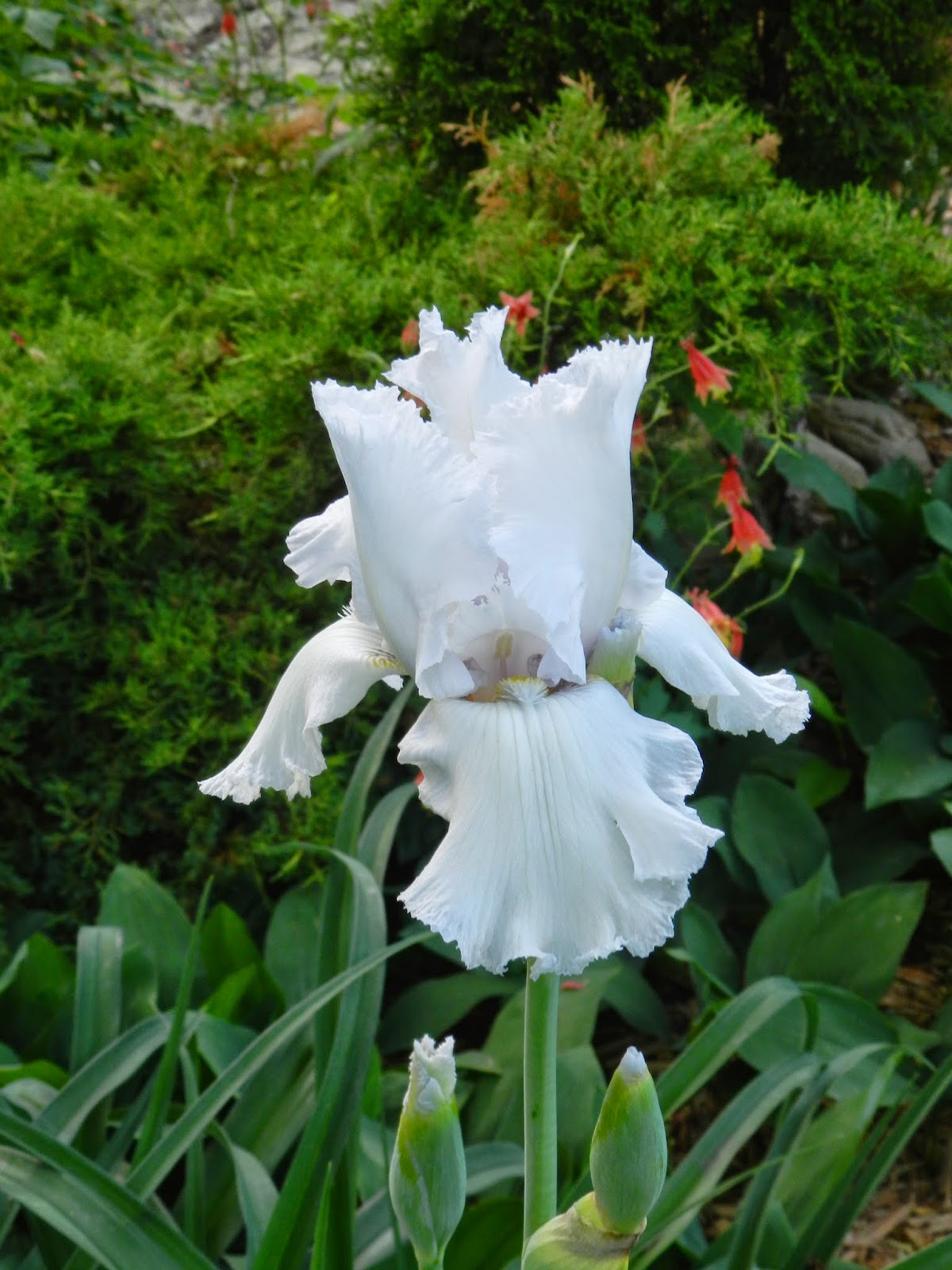
Germanica Iris "Lacy Snowflake" is a Schreiner iris.  Check out
their catalog if you want to be amazed.  I got this in 2009 from
Hornbaker Nursery, Princeton, before they discontinued their large iris beds.
This 1844 Heirloom "Mme. Chereau" is small and sweet.
It fragile and quirky but so lovely.
This Heirloom (1597) "Pallida Dalmatica" has been divided so many times, they're
all over my yard.  In Gerard's 1597 Herbal, he called it the "great Floure de-lice of Dalmatia".
It's used in Italy for perfumes and gin.
This 1909 Bertrand Farr iris "Quaker Lady" has all the delicacy and beauty
you could want from an iris plus it multiplies quickly.
Iridaceae "Red Zinger" is all that and very fragrant.  It's an award winner
and with good reasons.  
Heirloom "Wabash" is the background for this deep purple and very fragrant
iris.  I've no idea the name or where it came from but I'm grateful it's in my garden.
Wabash is a quick spreader and holds up well to rain.
I call this little beauty "Mom's French Iris" for sentimental reasons.
It's perfect against the gold bush.

I have quite a few bunches of small to tiny - lavender to purple iris that
people have given to me.  They are sweet and fun and thank you everyone.
If you're crazy for iris, check out other articles by looking to the right under "iris" - now how easy is that?