Thursday, May 15, 2014

Strange Bedfellows


Purple hosta flowers and daylily "Orange Vols"


We seldom see orange and purple outside of Halloween decorations because they both are strong colors with distinctive undertones. 
Purple "Wayside King Royal" and orange "Quilt Patch"

For the basic art lesson:  Purple is a combination of red and blue.  Orange is a combination of red and yellow.  The amount of each color or the addition of white determines the exact shade. 

In nature, no matter what shade of purple and orange (from deep jewel tones to sweet pastels) these two colors enhance each other.  I found this out accidently.

This is the patch of unknowns I talk about.
I was the happy recipient of many garden plants when one person moved from a large yard to a very small yard and another person was going to remove an English garden to put in a dog run.  None of the plants were blooming and were identified only if I could recognize the leaves or roots. 

A whole gob lot (that means an un numbered amount but more than a few) of them were obviously daylilies although I had no idea the height, color, or bloom time.  Since there were so many, I enlarged a hosta bed where it was getting more sun, plopped in a couple of rows of daylilies and waited until the next summer to be surprised. 

"Midsummer Elegance" and "Mini Pearl"
The biggest surprise was a hybrid glowing deep orange next to a very dark jewel-toned purple velvet.  They bloomed at the same time and the dark purple was the perfect foil for the bright orange.  They made each other more than they would have been standing alone.

Another combination was lavender and peach.  The softness of these two colors tended to look like someone had pulled saltwater taffy in the most perfect swirl of luscious colors.

The actual trick with orange and purple combinations is the common red in them both; it ties them together.  But don’t misunderstand and think you can put a red flower in the middle of them and have it enhance the orange/purple combo; it does not.  Adding a red flower in the middle of a purple/orange area is like sending in a bad flute player for the High Society Band, it sets your teeth on edge.

Unknowns and a little red slipped into the scene.
Does orange and purple work with other flowers besides daylilies?  Most definitely.  The herbs “lavender” and purple salvia are one of my favorite backgrounds for the garden.  Add orange shades of marigolds, cosmos, begonias, gladiolus – the list goes on and on – and the whole garden gets lively.

It’s a little trickier with foliage.  There are shades of purple and orange (either/or) in grasses, coral-bells, ferns, hosta and coleus.  Combining them isn’t always as successful as the flowers because the shades may vary each year or by location.  Most foliage has a combination of several colors in the leaves and some of those other colors may not mix well.  If you want to try combining orange and purple foliage, I’d suggest having them in hand at the same time at the nursery BEFORE buying.
Large peach and small purple 
Realize most perennials have varying bloom times and if you want to have the two colors enhance each other, make sure you understand those times.  As an example, daylilies have early, very early, midseason, late and very late bloom times. 

Annuals can be depended on to bloom from early summer until frost and that makes them perfect for an experiment in this color combo.

A tip for enhancing both colors even more is to add a white flower for the third mix.  Soft baby’s breath, white petunia, Shasta daisies, zinnias, gladiolus and more.  White looks good with the strong colors and the soft muted pastels. 

"Margaret's Choice" and "Trahlyta"
Can you mix lavender and peach pastels with strong purple and orange?  Yes, but again, you may want to hold them in hand prior to buying.  And realize the pastel plant will become the background plant and the jewel tone will be the one everyone notices.  It will no longer be two equals enhancing each other; one will be playing a supporting roll.  If the pastel is a gorgeous plant on it’s own, it seems a waste to put it in the second fiddle roll.

And another little hint:  If the purple has too much pink in it, it will not look right with the orange.  Last week I saw a lovely medium peach petunia put alongside a purple and pink foliage and it didn't work.  Sounded right but put side by side it was off. 

 Enjoy combining unusual color combinations.  The worst that can happen is you move one of the perennials next year or you don’t put those two annuals together again.  The best that can happen is a stunning beautiful surprise.  Don’t be locked into tried and true – go bold and experiment.  It might be “What was she thinking?” or it might be “Oh! my! gosh! she’s a genius!”   Worth a try don’t you think?


Tuesday, May 13, 2014

What's an Average Guy To Do?

This little succulent ground cover withstands dry 
and baked clay soil with no problems.
I fall somewhere between "the world's environment is in chaos and we're all gonna die today" and "everything is beautiful in it's own way - fa la la la la."

From what I read and observe, it does appear some of our past weather may not be what we should expect in years to come.  Whether this condition is man made, nature doing it's thing or simply normal if assessed over a long period - time will tell.

I follow a science blog and they assert man has been the cause of all changes and disasters - period and totally.  I follow another site that totally debunks all scientific data and they say it's been like this forever and will be forever.  I fall somewhere in between and not necessarily in the middle on different issues.

Donkeytail Spurge is funny 
looking and hardy 
Historic data substantiates weather and environmental differences come and go.  Although US weather data doesn't go back more than a little over 150 years, it does point to disasters rearing their ugly head  on a rather regular (but not necessarily often) basis.

Scientific data does accurately document how some changes are in areas that have had the most negative environmental impact.  This data often takes small portions of a situation and jumps from that data to an all sweeping generalization.  By that I mean data from reports (an example only for making a point) would theorize because there are fewer blue eyed humans in the world than ever before, and blue eyed people are more susceptible to the damage from sun, then it must be that the sun exposure is the reason there are fewer blue eyed people.  Faulty conclusions to related facts.

Because both sides of the hype may pull any related data to substantiate their claims, it tends to negate their findings.  Zealots for any cause become blinded to anything other than own conclusions and pick and choose data to support the wanted end conclusion.  Too bad since we need to be accurately informed and take the right measures to continue to care for our world.

In the recent report talking about drought and water supply, my recurring thought was this is an excellent opportunity for scientists and inventors to be on the front end of new devices and methods to work within these changes.  Too often all we hear is doom and gloom statements.

Sedum "Pink Chablis
It reminds me of a supervisory tool I used in my prior life where I never let an employee bring a problem to me without also giving a solution.  It kept whining for whining sake to a minimum and it encouraged employees to think beyond their own duties and often it was a great solution.  I wish those that report doom and gloom and the news media had that same criteria.  Hopefully, some new-bee will jump on the situation and show we still have the ability to think and develop new ideas for this world's changes.

Then there's the gardening portion I'm working towards:  Why not try a small plot of land designed for dryer conditions?   Something that survives extremely cold winters and drier summers?  IF indeed our future is for different weather, why not experiment with gardening for those conditions right now and at a more leisurely pace than if it's actually a reality?  Some ideas:

A succulent filled bed.
A stone garden (think Japanese gardens)
Sending your rainwater into a rain barrel for later distribution.
Directing your downspouts to specific areas needing more moisture.
Researching what plants take the least moisture but still withstand heavy rains.

Zebra Grass
There are many MANY articles about how to conserve and repurpose our natural resources.  If you start little, you might find yourself on the cutting edge of an idea.  Or you may simply make a beautiful and different garden within your Midwest yard.

And as a warning:  Do not believe all the hype on either side of the claims and arguments.  Consider if the person is trying to sell you something which may skew their data.  Realize some passionate folks skew data without ever realizing they have picked up the zealot's sword and are rushing into the battle without their pants.

Enjoy your day even if you're in snowy Denver or rain parched California.  Today, in Illinois, we are experiencing spring thunderstorms - what a blessing.


Monday, May 12, 2014

Happy Birthday Richard Feynman

Flowers on our plum tree.  The predictions about all spring blooming
buds being killed by the severe winter didn't come true - yeah!
Daffodils last forever and I've started buying up any different kind I find
at a low cost and plopping them at the edge, in the middle and
along paths in the woods.
I've never heard anyone say "Darn! I have too many."
One of the most brilliant scientists that ever lived would have been 96 on May 11th.  Out of his many quotes, I like this one:  "We are not to tell nature what she's gotta do.  She's always got better imagination than we have."  He may have been referring to lofty ideas but it applies to gardening, too.

My yard has been exploding with new growth and beautiful flowers.  Without a lot of talk (you're welcome very much) here are some recent pictures.
If you can only have one spring flowering bush, Pink Flowering Almond
is perfect.  

They predicted no lilacs would bloom this year because of the cold
winter - wrong-O.  Happy-O!  

One of the few ground covers I recommend: "Archangel - Yellow Variegatum" has
beauty but isn't a thug.
Although they are pretty much nondescript most of the year, Redbud trees
are spectacular during Spring.  Perfectly wonderful.

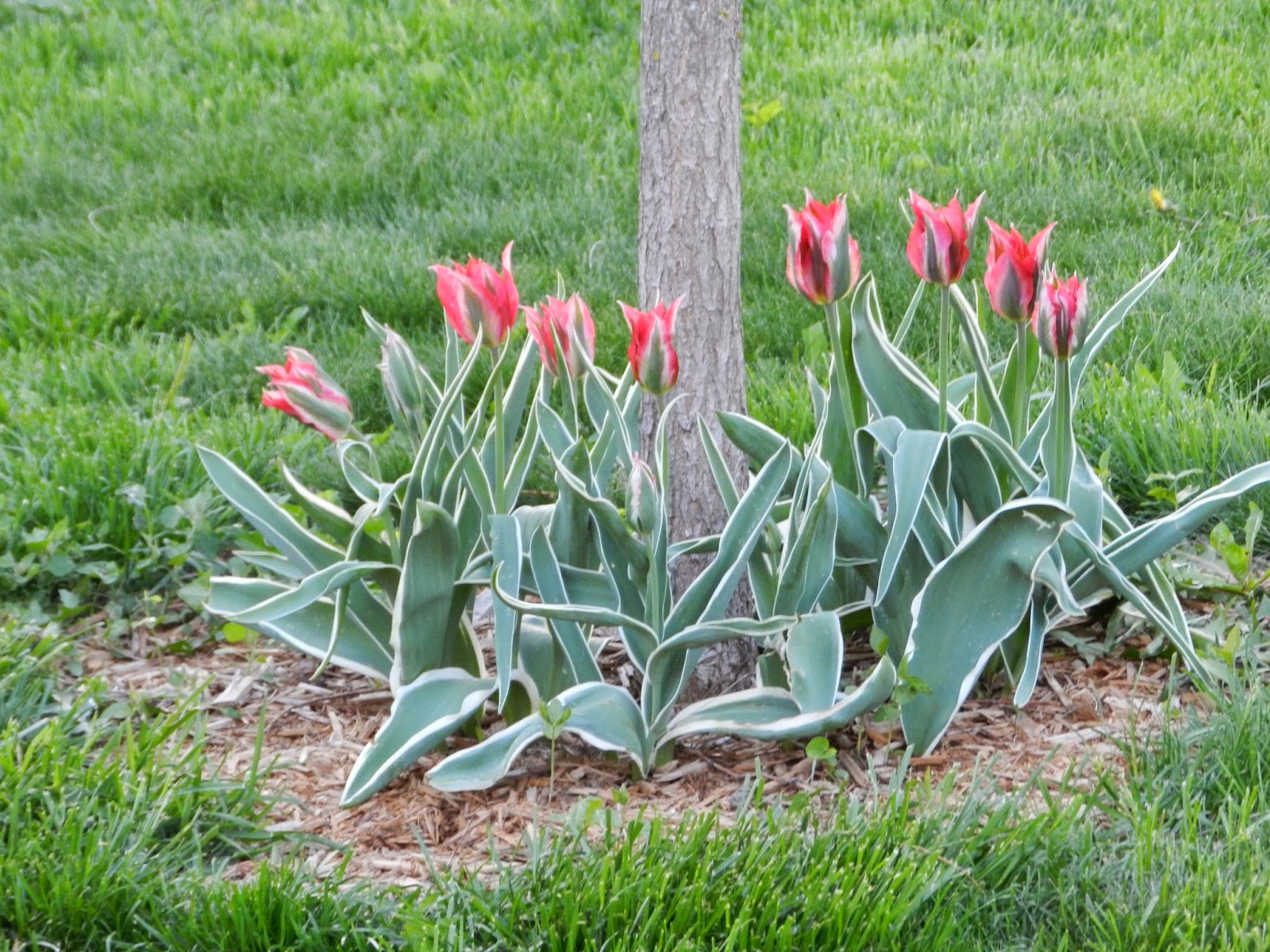
These Parrot tulips were planted when we put in the tree - a good way to
have both and not damage roots while digging.


Saturday, May 10, 2014

Fern Gene Has Strange and Sexy Origins

Following is an article published on May 8, 2014 by Stephen Luntz for IFL Science.  I have copied instead of rewriting.  It's pretty darn interesting for those of us who simply love the scientific portion of gardening.  (Photos are mine from a patch I moved in from a previous home in about 1997.  It continues to thrive and spread.) 

Ferns may look wholesome but they've been caught getting frisky with relatives of moss, picking up DNA vital to their modern success in the process.

Forest-floor dwelling ferns use a protein called neochrome to chase the limited light available. Where they developed the gene for neochrome has been an intriguing puzzle with several improbable answers. But the latest explanation is more surprising than any of them.

Neochrome is “chimeric gene”, fusing blue and red light sensing proteins. It was a puzzle because a green algae species has it too, suggesting the gene might be very ancient but strangely lost to other species or evolved independently. An alternative explanation is horizontal gene transfer (HGT) from one species to another.

Now a paper in Proceedings of the National Academy of Sciences concludes the algae neochrome was a red herring, with differences from the fern DNA . Hornworts, humble relatives of moss, evolved neochrome independently from the algae. Ferns and hornworts having been evolving independently for around 400 million years, but Fay-Wei Li, a PhD student at Duke University, and colleagues from a host of other institutions found ferns gained neochrome 180 million years ago. This explains why the most primitive ferns don't have it, and those that do, including Cytheales and Polypodiales flourished on the floors of Cretaceous forests when broadleaved plants appeared.

The authors note, “Despite being one of the oldest groups of land plants, the majority of living ferns resulted from a relatively recent diversification following the rise of angiosperms. To exploit fully the new habitats created by angiosperm-dominated ecosystems, ferns had to evolve novel adaptive strategies to cope with the low-light conditions exerted by the angiosperm canopy. Neochrome, an unconventional photoreceptor that allows ferns to “see the light” better, was likely part of the solution.”

Furthermore, while HGT is not as common in plants as bacteria, who trade genes like Pokemon cards, evidence is emerging it is more common than we previously realized. Adding to this is the discovery that the neochromes in ferns have a far more jumbled and complex relationship than the species of ferns in which the genes sit (see image below). Neochrome genes have been flitting between fern species like bees between flowers.Some genes are just a whole lot more promiscuous than others, and it seems neochrome may be rich in the transposons (or jumping genes) that facilitate species swapping. On top of this ferns are almost unique in that their gametophyte, or sperm and egg producing organs, can live independently. During this stage the gametophytes “have no protective layer on top, no cuticle," says Duke's Professor Kathleen Pryer. Perfect conditions to share a few genes, particularly in the moist environments ferns favor.

Li notes ferns are the only lineage of land plants that lack a reference genome and is working to correct this, which he hopes will reveal if HGT is common for other genes as well.
  
HT Scientific American, for much more detailed coverage of this story.


Friday, May 2, 2014

Skirtin' On the Edge of Normal

What is normal?  Our old friend, Webster, says it's conforming to the standard or the common type; not abnormal; regular; natural.

From all the weathermen tell us, this winter has NOT been normal.  No big surprise to anyone who lives in the Midwest or about any other place in this beautiful U.S. of A.

Speaking as someone who occasionally walks on the edge of Abby normal, I've rather enjoyed some of the crazy weather this winter.  I have the option of staying home in bad weather and can simply look out our big picture window and smile.

And now we enter the tornado season and I can unequivocally tell you it's my least favorite.  Loving spring flowers and the incoming warmth tends to blow to the background when the weather alert siren starts shrieking.

Consider these spring storm preparations:


Have a plan and make sure ALL the family knows the plan.

Consider the cell phone and computer free weather alert apps.  These let you know if there's a severe storm or tornado even while your away from home or outside gardening. 

Install internal surge protectors and if your home is often near lightening strikes, your utility can install an external whole house surge protector for a monthly fee.

Prune tree branches that hang over your house.

Make sure your cell phone is charged.

Go to the basement or inside room when a severe storm or tornado is imminent.

Find shelter someplace else if you live in a mobile home.

A car is just another projectile, find shelter someplace else.

Do not stand outside to take really great pictures during a tornado.  Duh factor!

No one ever died going to a safe shelter too soon.  

If your family finds it so very not cool to go stand in the basement, have an old radio (with batteries), a six pack of water, a box of snack food, a deck of cards and a flashlight in a box where you'll wait.

If you are going to the shelter in ample time, take your purse, billfold, glasses, meds, flashlight, cellphone, and anything you can't live without.  Do not search for these things AFTER the weather alert says WARNING.

I head for the basement if there's a tornado warning and if the weather looks threatening.  I've been asked if I'm afraid of storms and I'm not.  I love the looks of really angry clouds.  BUT and this is a big but:  I've been around tornadoes and I've been in tornadoes.  I have a healthy respect for what they can do and the human body simply hasn't a chance if you don't act wisely.  

Stay safe - we need all our gardening friends!

Check out my "Storms"article on spring weather if you want more info.  

Thursday, May 1, 2014

Midwest Tropics


Head cabbage looking like a rose


The other day I was reading an advertisement from one of my favorite on-line nurseries:  Annie’s Annuals and Perennials.  Annie’s is from that state that’s a world of it’s own, California.  They embrace the unusual much like New Orleans except with better weather.   But I digress. 

Annie was featuring edibles used as ornamentals; something I’ve been preaching for several years in this column.  Now some of those edibles are absolutely FAB-U-LUSIOUS! 

Beautiful purple Kale
You may wonder:  “Does Diane really buy plants from California?”  Well, no I don’t.  Even though Annie carries some of the most FAB-U-LUSIOUS plants I’ve ever seen for sale, the shipping from that side of the US is more than the plant.  I read Annie’s columns, enjoy her photos and think of ways to adapt our Midwest varieties to her ideas. 

Then. I realized I wasn’t looking at our varieties with the same “eye” I use when I look at her photos.  I’d accepted vegetables as commonplace – maybe because we live in the middle of soybeans and corn. 

For those of you who need visualization in the form of photos, check out my blog.  For those of you with a hefty amount of imagination, I’ll paint a tropical picture using veggies.

Red cabbage roses
Cabbage plants (no matter what color) look like really HUGE roses blooming wherever they’re tucked. 

The herb Sage is from the Salvia family.  It resembles silvery Lambs Ear and Dusty Miller except it is very VERY fragrant if touched and is a perennial in my yard. 

This will grow into 3 foot Kale

Kale is the new “every chef has to use it in every recipe and wax on about how wonderful it is”.   Fact is its extremely good for you.  Now the pretty part:  The plant is dark blue/green and the long leaves can reach three foot in some varieties.  Truly tropical looking much like a pineapple plant.

Other beautiful “greens” are the brightly magenta or gold Chards, deep green collards and spinach.   

Grapes are a perennial vine that needs little fussing and has the benefit of fruit.  A great alternative to climb a trellis, oblique or fence.

Lettuce comes in such a large number of colors, sizes and textures, it can be added to pots, flower boxes or in front of beds. 

Need color?  Cherry and pear tomatoes come in white, yellow, red, purple and a deep chocolate.  Pepper plants in the same colors and many shades of green.  They can climb or there are dwarf varieties.

The herb Rue - host food to caterpillars of butterflies
I could list every herb known to man and most of the list would look tropical in the Midwest garden.  Some would be annuals.  One that many love is Cilantro.  It has lovely little leaves and near the end of the season pretty white flowers.

Looking for height, plant a few tall okra plants.  The leaves are large and funky and if you have even a little southern in you, you’ll be tossing these babies in soups and other stuff that simply grosses me out – sorry…

A rhubarb patch has “pie” written all over it and the large leaves and red stems accent the garden.  It will gradually increase the patch size over the years.  It sends up a large flower stalk at the end of the season much like a yucca plant.

Sweet corn, maze, popcorn and others in this family certainly look like a tropical forest if planted in a circle instead of in rows.  Much like bamboo without all the invasive habits.


Can this eggplant's color get any prettier!
Eggplants are such a surreal luscious color of purple it begs to be in with your flowers.  One of the best plants if you are into neglecting your garden and a perfect plant to help make hummus.

Asparagus looks like Asparagus fern only much larger.  In green, shades of pink and a rich purple, a corner of the garden is perfect for this perennial and wonderful plant. 

Have I listed every vegetable and herb that would be perfect in flowerbeds?  Nope, not by a long shot.  Next time you visit a local nursery looking to enhance your yard and planters, stop by the vegetable section first.  The cost is comparable to flowers, often cheaper, and they do double duty.

 Midwest tropics?  It’s as easy as a sunny day.