Thursday, February 16, 2012

Y is for Yucca

In the Midwest, Yucca Filamentosa is typically seen in older gardens, cemeteries, and public areas.  In more arid parts of the country yucca may grow nearly everywhere and often wild.  They can, also, be grown as a house plant.

I don't see yucca in many local nurseries and certainly there aren't a lot of varieties hardy to our zone.  I bought my yucca at the Garden Station in Monticello, Indiana.  My variety is "Golden Sword" and is hardy to Zone 4.

Yucca is a good plant to consider if you're wanting to water less - or - designing a xeroscape garden.

Yuccas should be planted in poor soil, have excellent drainage, and full sun.  They especially don't like standing in winter water.  Raised beds with good drainage work well.  The root neck especially should not get soggy.  It's why you see some outstanding yucca plants with a 2 inch layer of small stones or granite chips as mulch. 

If planting in a large hole or raised bed, put a 7-15 inch layer of gravel in the bottom.  Set up a drainage bed especially if you have clay soil.  Add gravel to clay soil to make it 50% soil-50% gravel.  This isn't a picky plant, but it will certainly die from rot if it doesn't have good drainage.

I've never had one live that had been transplanted from other people's gardens because they don't like to be moved.  It's suggested buying from a garden center.

If neatness is your thing, you can cut off dead leaves.  ALWAYS wear thick garden gloves when planting or working with a yucca; the leaves are sharp and can cut a finger off - yes off.   That brings me to a word of caution:  If little children or others can run into the plant - you may want to either not have a yucca, put where there is no traffic, or have a barrier around the plant.

My yucca has beautiful striped two-toned leaves, the reason for the name.  It turns a bright pink in the winter.  Some of the old varieties are a dull medium green or blue green year round. 

Most yucca bloom.  The flowers are often on tall (6 ft.) stems, cream colored and are called fragrant.  The fragrance is a mild soap smell.  They bloom summer through fall.  It's alright to cut the flower stalk off after it blooms. 


Cool information:  They are used by certain moths for mutualistic pollination which includes food for the larvae.  It's an interesting little series of moth events if you'd like to read more.  Some species will not pollinate without the Yucca Moth.  To flower, some species need more than one plant.

Stuff:  There are different species and sub species so it's best to read before you buy.  They have had many practical uses for the Native American Indians.  Some of the new hybrids stay relatively small - others may become trees. 

Common names:  Yucca: Pale; Spineless; Spoonleaf; Palm; Banana. Adam’s Needle, Soapweed, Joshua Tree, Ghosts in the graveyard, Spanish Bayonet, Spanish Dagger, Palma China, and Datil.

I'm still hoping to put a couple beside my driveway.  I like the look of sentinels standing watch.  They are almost like giant gate posts.  It will take lots of soil prep since I'll be dealing with field clay.  They do make outstanding feature or accent plants.  Plant them right and they will be there probably longer than the homeowner.


Top two photos are from my garden.  Bottom two photos are from www.yuccado.com   Most of their plants are not hardy up here although they can be great houseplants.  It is where I get my very favorite plant tags and stakes: DooHickey    

Sunday, February 12, 2012

Perky Perky

Perky. Perky. Perky.   I've talked death, politics, left and right wing, gray skies and I'm ready for perky.

Bright flowers fall into the perky category for me and there are some real beauties out there this year.  I'm going to borrow most of the photos from on line catalogs - give credit where credit is due - and the only endorsement I'm giving is to say the photos do look beautiful - - - and perky.

 This beauty is called "Amish Cockscomb" and it's featured at Baker Creek Heirloom Seeds www.rareseeds.com   This variety was discovered growing in an Amish garden near Arthur, IL. Beautiful large red heads on compact 1-foot tall plants.  

I haven't seen cockscomb growing in gardens in years.  I plant a few every few years and always wonder why I don't do it more.  Children love it and it really packs a punch in late summer when other flowers have stopped blooming.


The antique Sweet Pea "Queen of the Night" from Renee's Heirloom Garden www.reneesgarden.com  The Queen has super fragrant blend in the deepest shades of navy blue, mauve-blue, bicolor maroon and lilac, dark crimson and salmon pink.

This is grown as an annual up here and could grow to eight foot.

People shy aways from sweet peas for some reason.  There are also perennial varieties.  They won't grow where there are walnuts (sigh...)


The stunning Union Jack dahlia from 1882, is one of the world's oldest.  It's also known as the "Star of Denmark".  Featured in Old House Gardens, a heirloom bulb supplier  www.oldhousegardens.com  plus they have loads of information. 
 
The good thing about dahlias is you will have the bulbs from year to year (plus all the babies they produce.)  The bad thing about dahlias is they must be dug up in the fall/replanted in the spring. 
 
Nothing beats dahlias for the huge formal wow factor.


Campsis "Minnesota Red" Trumpet Creeper is one you may want to consider the fact it can grow in Zone 4 to 40 feet.  Do not plant where it can damage siding or trees.  I have mine planted on a twelve foot stump of an old tree.  This native vine  is from Brushwood Nursery at www.gardenvines.com                                                                      


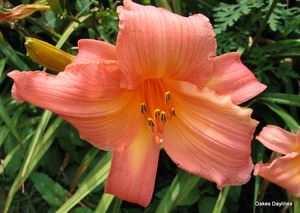
Oakes Daylilies at www.oakesdaylilies.com is where I bought my stunning "Dorothy Lambert".   Registered in 1966, it is a vibrant rosy pink 6 inch flower that is often called tropical.  Anything but tender, it is hardy to Zone 4.


Hope you've enjoyed some bright perky flowers because tomorrow we have snow predicted and I'm so sure a little perky will be just the ticket.
 
“In my garden there is a large place for sentiment. My garden of flowers is also my garden of thoughts and dreams. The thoughts grow as freely as the flowers, and the dreams are as beautiful.”   Abram L. Urban


Love Is In The Air

Does the love of your life want roses for Valentine's Day or can you go a little into the garden scene for a sweet treat?

If you have a love, and you get a valentine's present for your love, and you haven't had "specific instructions" - Perhaps some of the following might expand your options.

I realize some recipients only want big and expensive and specifically REALLY big and expensive. 

I realize some recipients want a beautiful card, the traditional dozen red roses, heart shaped box of chocolates and dinner at a fine restaurant.

The reason I feature the photos of wine gift baskets is to help you towards thinking about some different types of gifts for this valentine's day.  If a gift is nice, is thoughtful, and something the recipient actually enjoys, why not go different?


Think about these:

  1. Gift certificate from a nursery
  2. A trip to a nearby botanical gardens - including lunch
  3. A new set of garden tools
  4. Ergonomic rake, shovel, or hoe
  5. A red wide-brimmed garden hat
  6. A water feature for the yard - plus installation
  7. A computer program to record garden plants, etc.
  8. A camera with a good zoom lens
  9. And for the adventurous - a wagon load of aged manure
  10. Bird houses and feeders 
  11. Subscription to a garden magazine or a new garden book.  (if you subscribe for a Kindle type device, make sure it will download photos well or it is pretty worthless for looking at beautiful gardens.)
Should you both be gardeners:

  1. A set of his and her outdoor lounge chairs
  2. A large patio umbrella
  3. A ceiling fan for the porch
  4. A train trip to an area of the country for an annual flower convention or tour of historic gardens.
  5. A tree
  6. A pergola
  7. Outdoor cooking devices
  8. Weather station
Warning:  If you've got the traditional kind of love in your life - do not and I stress DO NOT attempt to break that tradition on Valentine's Day.  There is nothing wrong with red roses, chocolate candy and a great meal topped off with something from your favorite jeweler.  The point (aside from increasing market sales) is to show love and that you care.

Budget minded:  If you are in your lean years (I mean financial not weight) - a love letter could be the most important and favored gift you ever give to your sweetie.  
  

Friday, February 10, 2012

Out of Style?

The other day I heard someone described as "classy" and "dignified".  I realized it's been a long time since I'd heard those descriptive words used. 

According to my Websters:

Classy is slang for something elegant or stylish.

Dignified is marked dignity of aspect or manner; noble; stately. 

Do you think the reason for disuse comes from:

  1. There are fewer classy or dignified people or things?
  2. Today's descriptive slang uses different words?
  3. The words are of another generation?
  4. Maybe all of the above?

Classy and dignified can definitely be used in the garden world: 

  1. How a plant looks and behaves.
  2. How a garden is composed or designed.
  3. The manner an insect or bird goes about it's tasks.
  4. The position of a plant in a photograph.
  5. How a gardener presents his or her self to others.
  6. The descriptions or claims in a catalog or nursery.
  7. The design of garden structures.
  8. Maybe all of the above.
I always considered classy and dignified a positive attribute - still do.  Hope these descriptive words don't fall into such disuse that the the description or behavior are removed from society. 

On that note, I read an article stating what 2011 descriptive words are now "OUT" and using them in 2012 means you're not up with the times.  I realized I didn't use any of them in 2011.  Does that mean I'm so out - I'm actually in?        

Thursday, February 9, 2012

Purple Tomatoes?


I grow a few heirloom tomatoes every year.  I consider them fun and in the process I've had some favorites.  The Cherokee Purple (Solanum lycopersicum) heirloom tomato tops my list of favorites.

When growing heirloom tomatoes be prepared to "think out of the box" on flavor, looks, texture, seeds, disease resistance and production.

The flavor of a Cherokee Purple is a very VERY sweet old fashioned tomato taste.  One of the best for serving fresh.

This plant doesn't have a huge production of tomatoes - plant with other varieties if you plan to use with lots of cooking or preserving. 

As you would expect from a tomato named "purple", don't expect to see bright tomato red.  As the photo shows, it's green and purple and dark red when ripe. 

This tomato has very dense insides, translating into good sauce and juice.  When cooked, it will tint the product a darker shade of red. 

It takes a lot of moisture to do well in the garden.  During drought years, you will need to water deep twice a week for high production and to stop the skin from splitting.  Insects love a tomato that has a split.  During perfect summer weather, they are relatively maintenence free.  Otherwise, keep watch for the usual tomato problems and fix early.

As this Burpee catalog photo shows, the tomatoes are large, dense and heavy (about 12 oz.).  The plant should be supported on something sturdy.  They take about 80 days from the time the plants are in the ground to production.    

If you get plants in the garden early, they may grow over six foot.  Keep that in mind when your placing in your garden plot.  There are catalogs featuring organic tomato seeds if you care to raise your own. 

Cherokee Purple was the first "black" tomato.  It is considered beefsteak style.  Craig LeHoullier claimed the cultivar is over a century old and originated with the Cherokee Native Americans.  It has been included in the Seed Savers Exchange as a heirloom.         

A gentleman developed his own web page for the tomato:    www.cherokeepurple.com
I have to admire a person who is so excited about a single variety of tomato, he has  dedicated it with photos of every stage.  I tend to do this with my daylilies, so, I can understand that kind of passion. 

If you're a tomato lover - one that anxiously awaits your first tomato sandwich, one that eats cherry tomatoes straight from the plant, one that always plants more than a sane person can consume - aren't you almost tasting that fresh tomato as you read this article???    Soon - very soon!  

Wednesday, February 8, 2012

2012 The Year of the Herb

The National Garden Bureau and the Herb Society of America have named 2012 the Year of the Herbs!

The International Herb Association has named 2012 the Year of the Rose!

Looks like a busy year for gardeners striving to be involved in the year of herbs and roses.  Members of these respective non-profits voted their "Top Ten" list:


  1. Sweet basil (Ocimum basilicum)
  2. Chives(Allium schoenoprasum)
  3. Dill (Anethum graveolens).
  4. Greek oregano (Organum vulgare hirtum)
  5. Bay (Laurus nobilis)
  6. Rosemary (Rosmarinus officinalis)
  7. Common thyme (Thymus vulgaris)
  8. Parsley (Petroselinum crispum)
  9. Common sage (Salvia officinalis)
  10. Lavender (Lavandula)

The IHA is promoting the rose as a herb because of the many edible uses for the petals and the seed heads.  The seed heads, called hips, are a common ingredient in teas, herbal medicines and natural vitamins.  (Use only roses not treated with chemicals.)

How easy to get involved in this year's herb extravaganza.  Grow from seed or buy plant sets.  All of the above "Top Ten" are easily found, pretty easy to grow and can be used in your cooking and food preservation.  Not to mention they are lovely plants in the gardens.
____________


I typically don't lay down in front of moving traffic for my ideals - although I do occasionally pick up the pen for what I consider a deserving cause.  Today, there appears to be one looming in California at UCLA.  Check out  http://www.hannahcarterjapanesegarden.com   If you find the cause to preserve this garden something you care to support, sign their petition.  They need 2,000 signatures. 

___________________ 

It's especially difficult to insure even the simplest home gardens will be preserved once the original gardener sells the property.  It may be the new owners simply can't afford the gardens, doesn't want or can't  work at gardening, loves the house/hates the yard, has different tastes or priorities, or who knows...   With the above Hannah Carter Japanese Garden, even a trust with an organization and signed legal documents aren't insurance a national treasure will be preserved.  How less insured is a simple family garden.

If gardening is your passion, I suggest you involve your family - the next generation if possible.  It's a reason to take time from the process and enjoy the beauty you create.  Photograph your gardens and invite others to enjoy your works.  As-much-as most of us think our particular garden is wonderful, the next resident may not.  (Right here I visualize many a gardener clutching at their heart with a little whimper of disbelief!)  I know, who wouldn't love the daylilies, the old walnut trees, the hosta, the old brick paths, etc. etc. etc.????  

My garden instruction for the day:  
Enjoy your gardens every single chance you get.  


“Who loves a garden still his Eden keeps, perennial pleasures plants,
and wholesome harvests reaps.”
- Amos Bronson Alcott, American educator, philosopher (born 1799)


Tuesday, February 7, 2012

Thick as Soup

A few pretty photos taken during one of our recent fogs.  Another reminder so many weather conditions often produce beautiful photographic opportunities besides those in full sun. 
Little bird perched on a frosty bush.
Always busy, a resident squirrel is in his favorite walnut-eating place.

Our weeping willow is always beautiful and even more dressed in the hoarfrost.

Fog and frost lend an aged appearance to photos.  This picture of an old barn might be today or fifty years ago. 

Old trees by the former strip mine lands, lean towards the road.

As the sun pushed through the fog, layers of "clouds" rose from the tilled fields.


Off subject, here are three pots trying to sprout.  I had place the left pot out in the garden late last spring.  I tossed it in a bed and pretty much forgot the leftover Easter lily.  "Assumed" it was long dead/ruined one winter day so brought the pot inside, sat it on the garage work bench and forgot to compost.  Last week I noticed it had sprouted!  What fun.  Sometimes procrastination works!  The other two pots contain Amaryllis bulbs I'd stored in a paper bag in the basement.  (I never seem to have the time to get them going for a Christmas display.  I was once told by a visitor to my home that I shouldn't have them in March - only at Christmas.  Aw well, we each have our own opinions...)  The one in the plaid container had already started it's sprouting - perhaps a reminder it was ready for Christmas blooming after all.  At any rate, I'll have some pretty awesome flowers in a couple of months.  

Side Note:  If you'd like to read more about hoarfrost, check out a past article "The Snow Fairy Was Here"  #109.