Saturday, July 9, 2011

Be A Big Girl

We spend the first years of our daughters' lives telling them to be a big girl and when they reach teens, we wish they were little again.  Fortunately, by the time they're grown, we appreciate what a lovely big girl they've become. 

I have a few big girls in my garden and I'm grateful they grew up so nicely.  They are the really large daylilies.

  • Large daylilies can be used in large yards because little flowers often get lost. 
  • They can be a singular plant - to form the spotlight.
  • Used at the back of an area, they draw your attention down a walk.
  • Many large daylilies are spiders or unusual forms.
Here are a few of my large lilies:

"Chicago Star" is not only big, she has a very high bud count, is sturdy and withstands the elements.  A bright yellow gold with a slight ruffle on the edges.  8 inch blooms on 24 inch scapes.  Mid season bloomer and over a long period. Semi evergreen.  Introduced in 1970 by Marsh.  Won the 1974 Honorable Mention.
"Lilting Belle" is my all-time favorite daylily.  It looks fragile and it's not.  Belle is a late bloomer and she keeps color in the garden when other lilies are beginning to wind down.  8 inch blooms on 36 inch scapes, semi evergreen.  Introduced by Wilson in 1983.
"Parade of Peacocks" took a few years to get settled into her grand performance.  It's been worth the wait for these 8 inch flowers on 36 inch scapes.  Mid to late season, dormant, hybridized by Oakes and introduced in 1990.      
It's been the perfect year for "Pavlova".  She tends to shred in heavy wind and rain.  Since we've only had one rain since she started her bloom period, it's been a beautiful show.  She looks especially stunning against dark green foliage.  Note the little "Knick Knack" peaking around.  10 inch blooms on 25 inch scapes, an early bloomer and is evergreen.  Hybridized by Lambert and introduced in 1963.
I took a chance on "Fly Catcher" and it hasn't disappointed.  In fact, it's one of those lilies that exceeded my expectations.  First year blooms are substantial, large bud count and healthy plant.  Reds always attract attention and this multi colored large lily draws the eye to where it sits.   7 1/2 inch blooms on 32 inch scapes and is a mid season bloomer.  Dormant.  Introduced by J. Miller in 1978.
"Chester Cyclone" is an unusual spider because the petals twist.  It's in the first bloom year and I have high hopes this lily will continue to increase in clump size and wow factor.  8 1/2 inch blooms on 30 inch scapes.  Dormant and mid season bloomer.  It  may rebloom.  Introduced in 1972 by Blake and it's fragrant. 
I nicknamed this unknown daylily "Big Banana" because of the shape of each petal.  I've divided it over the years and have clumps in most every bed on the property.  It's just that dependable and pretty.  A mid season bloomer.
Another unknown, I call this "Large Peach Dramatic" because when it's happy, it's the size of a large dinner plate.  It, like most teen girls, is a little high maintenance:  it doesn't shed it's spent blooms and they are so large they make the plant messy if I don't do this every day.  Some years the buds don't want to open in the morning without a little touch to help them release.  A mid to late season bloomer. 

Most large daylilies, require a little pampering to help them look their best.  Daily deadheading is usually a must.  Even the most tough large daylily will get a little torn and tattered in high winds and heavy rains.  Pets and children running through the lily beds may snap large petals.  Just like our girls, they are worth it when they mature and become great favorites.    

Friday, July 8, 2011

My Pretty

Here's a few of the beautiful daylilies blooming in my garden right now.  I like to head outside early before it heats up too much.  Deadheading, taking pictures and trying to put a few thousand Japanese Beetles into baggies. 
Have you ever noticed you have more pictures of a certain few daylilies?  They are the ones that stop you in dead in your tracks and elicit an "ooooooooOOOOOO" - every time.
Sometimes it's the color, or form, or a memory.  Even if you are in an actual daylily field when you purchase a plant, it may be a disappointment in your own garden.  Then - you take a chance on a new daylily and it is so much more lovely than you had hoped, you do your garden dance.
Some daylilies have good years and bad years.  Some only look good after they've been blooming a week.  A few don't hold up well in the sun, or wind, or rain. 
Others take a few years to get settled and then become a "wowzer".  Some take their time opening in the morning and a few hold their blooms well into darkness.  The descriptions of some lilies don't hold true in my garden and it can be highly disappointing or an unexpect beauty. 
Another group of lilies I've put in the wrong place - bad combination of colors, too short for the 2nd row, too intricate to stand out next to other lilies, etc.
I encourage you to take photos to record the performance of your lilies.  It's an amazing comparison through the years.  By recording the differences each year (date of first bloom, kind of winter, amount of rain, issues),  it puts the current year's performance into perspective.  For example, this spring was very wet and the winter held a deep snow cover = one of the best daylily shows ever.
  The photos are daylilies blooming for the first time in my gardens - Top to Bottom:  Blushing Summer Valentine ~  Chester Cyclone ~ Dad's Best White ~ Decatur Gentleman ~ Fly Catcher ~ Spiritual Corridor ~ Myth and Magic ~ Double Daffy.   Enlarge the photo by clicking on my pretties.    

Thursday, July 7, 2011

The Pollinator


Even with little agricultural knowledge, most of us understand we cannot have the most bountiful crops without pollination.  Its part of the cycle – its how most plants function – it’s the purpose of many plant parts, birds and insects.

It’s often the bane of allergy sufferers.  Since plants have pollen, we tend to blame all plants (some have been given a bad rap for years).  If you have seasonal allergies, you may want to research pollen more thoroughly prior to developing your yard.

Most seasonal allergens come from native plants and folks tend to put them in the category of “weeds”.  They grow in our roadsides and vacant lots – happily spreading their little pollen fluff balls (yes, fluff balls is my totally unscientific term) on the wind. 

One sure rascal is Rumex spp known to locals as Sorrel or Dock. They are in a genus of about 200 species of annual, biennial and perennials in the buckwheat family. The allergenicity of this weed is moderate to high.  Bad news it pollinates from April through September.  Even if you pull or kill every single piece on your property – the pollen is known for spreading widely on the wind.  This pollinator just doesn’t know when to leave a good party.


I call Sorrell or Dock a weed, but it is actually an herb.  There are male and female plants having no greater thrill than distributing the pollen so as to reproduce.  It’s such an adaptable plant, it grows over most of this continent and others except the most cold or arid. 


In fairness, through the years this plant has had many uses and has been cultivated for centuries:

  • The leaves may be pureed in soups and sauces or added to salads.  It has the flavor similar to kiwifruit or sour wild strawberries. The plant’s sharp taste is due to oxalic acid, which is a poison.  In small quantities sorrel is harmless; in large quantities it can be fatal.
  • R. obtusifolius or Butter dock’s large leaves were used to wrap and conserve butter.
  • R. hymenosepalus is a source of tannin used for leather tanning and the stems used for mustard-colored dye.
  • Dock leaves are traditionally a remedy for the sting of nettles.
  • So long standing, it is used over much of the world in native dishes and drinks.
If you use manure on your gardens, chances are you will be pulling dock for quite some time.  It does have a long tap root so make sure you pull it as soon as it pops its little head out of the ground.

Silphium terebinthinaceum (of the aster family) is Prairie Dock and an Illinois wildflower (you know those pretty little yellow daisy-like flowers seen on roadsides.)  It is not known to cause allergies.

In Illinois, we can’t limit or contain wind born allergens – there are too many and many grow wild.  If you are mildly or a short term sufferer of seasonal allergies, you may just need mild or temporary methods of dealing.  If you suffer a more severe reaction, you may want to become close friends with an allergist.  Wearing a mask, limiting your time outdoors, watching http://www.pollen.com and using air conditioning might help.  The severity of your symptoms, the effectiveness of your treatments and your desire to garden are considerations.


“They know, they just know where to grow, how to dupe you, and how to camouflage themselves among the perfectly respectable plants, they just know, and therefore, I've concluded weeds must have brains."  - Dianne Benson, "Dirt"

Pollen photos:  aaaai.org

Monday, July 4, 2011

Standing on the Corner

     Here I am standing on the corner of 4th and Freedom.  It appears to me and I know I'm not your world expert here, but ...  It appears to me, most every country on this earth has the capacity and capabilities to feed and nourish it's citizens. 

In countries where the citizens thrive and have been able to care and nourish it's citizens, it's because that nation and it's leadership fosters an environment for the benefit of all it's citizens. 

How many countries in this world have impoverished citizens because the ground would never again grow crops, the water is too tainted to recover, and no way to make it better?  No matter what side of the "developing" issue you stand on, it isn't the dirt - it's the government's leadership.

I'm often in awe of this area of our world - the black soil, the abundant moisture, the lush growth.  Through the centuries it has changed (some better and some worse) but to date no one has stopped us from developing, enhancing, protecting and utilizing it for our citizens good health.

On this July 4th, I'm grateful I was born in this country where we continue to try to make a better life for everyone.  We are never done and we should never stop trying, but, we are still allowed to try.  I do hope as we celebrate July 4th, we take stock of just how fortunate we are and be grateful for those who have helped defend our freedoms. 

I pray we don't take this beautiful land for granted while it ever so silently slips away.


“Until he extends his circle of compassion to all living things,
man will not himself find peace.” 
- Albert Schweitzer
     

Sunday, July 3, 2011

R Is For Red

There's so much to say about the color RED:


The color red is an intense color that reflects heightened emotions and senses.  When viewed, it enhances the metabolism, increases respiration rate and raises blood pressure.  "I'm seeing red." is an expression of anger. 

Because it is highly visible, it is used as a warning on stop signs and lights.  It brings a word or item to the foreground.  A "Code Red" is emergency language for someones heart stopped although that code has been adopted for other emergencies, too.

Red indicates courage and it's why it's in many national flags.  Red flowers at patriotic events symbolize valor.

Red stimulates people to make quick decisions and is used in the marketing world for that very purpose.  Check out the next time you see an advertisement in red - it is deliberate and could be a "red herring".
Red is used in literature, music and advertising to suggest erotic and passionate:  red-light district, "Lady In Red", The Scarlett Letter, red lipstick, and "paint the town red." 

Red is marketed as high energy:  race cars, energy drinks, games, sports, etc.

Certain races of humans were considered "red":  Ancient Egyptians and Native Americans.

A red front door in Colonial times meant "welcome" as well as in Feng Shui.  Red on the doors in Biblical times symbolized Christ's blood and evil would pass you by.

~ Red in the Garden~


Valentine's Day and red flowers are a given.  The red rose, thanks in part to the florist industry, is know as the universal flower of love. In addition to the rose, a red carnation or tulip signifies "love".  A red carnation marks a couple's first anniversary and is the flower for January births.

Veterans of Foreign Wars members and American Legion Auxiliary volunteers distribute paper red poppies in exchange for contributions to assist disabled and hospitalized American veterans.  The red poppy is used to symbolize blood shed on the fields of battle (Originally WWI in France).

All seasons have vegetation in the color red.  Our beautiful spring tulips, the daylilies of summer, maple tree leaves of fall and the stems of the Red Twig Dogwood in the winter are examples.

Red may be used in the garden in much the same ways as the rest of the red culture.  It evokes passion, love, highlights and adds a punch. 


A bouquet of red flowers, a glass of red wine, a pair of red flip flops, some red sunshine, and by golly we're sliding summer into love.   

Friday, July 1, 2011

LOVE Small Towns

Being an old farm girl, I still enjoy the local County 4-H fair.  It's wholesome, it's educational, it's family and friends, and it's small town at best. 

Our local paper had a "fair" insert and it was sixteen pages.  That's more than the Wall Street Journal on a good world news day. 

Since I had again been a judge for the "Horticulture Vegetable Plants, Horticulture Vegetable Market Basket and three categories of Floriculture", I take special interest in seeing how all the projects went, pictures of the kids going to the State Fair, competitions, carnival, royality and entertainment. 

A handsome young man, the County Fair Board President was pure farm boy.  Tall and lean with a big belt buckle and farmer tan where his cap rests.  Did my heart good to see a person his age so involved in making the fair bigger and better.

It was also rewarding to see so many parents and grandparents at the judging.  Parents who are able to take an active part in helping their children in 4-H are rewarded as much as the children.

Perhaps not for every taste in the world, the local county fairs have some pretty great entertainment.  In addition to watching the 4-H and open livestock shows, there's always the rabbit and various pet shows. 

The horse shows have a little something for everyone.  4-H project horses, open class shows, miniature horses, the rodeo and harness racing. 

Tractor pulls, pie baking, cooking, hobby displays, crops, skills and more and more and so much more for a few dollars admission.  Cost of admission and the cotton candy, elephant ears and some other stuff that only tastes good if you are at a country fair!

4-H has added many interesting categories for kids and I'm happy to see them pulling families that don't have farm opportunities into the organization.

And, I'm reading along, page 15, and I now have my fun for the day:  A photo of the "Scoop the Poop" game.  I'm telling you, "I LOVE small towns!"             

Thursday, June 30, 2011

OOeee OOeee Baby


Garden walks and public garden tour events are  "heating" up - along with the temperatures and humidity. 
climatron

Here's some hints that might make your experience a little better, more comfortable and healthier.
  • Check out the forecast for the day you plan to be touring, then be prepared.
  • Some events are in the evening hours when it's a little cooler. 
  • Take a light colored umbrella to provide shade.  A small one that folds with a loop handle.
  • Don't carry - pull.  Use a wheeled small carrier for all your stuff.  Call ahead of time to see if it's allowed.
  • Drink LOTS of water.  Nothing else hydrates better than water.   Alcohol causes dehydration.
  • Have a light colored hat that allows air to circulate; loosely woven with cotton inside binding.
  • Use sunscreen and re apply.  The non greasy ones aren't as hot.  Some come with insect repellent.
garden symposium

  • Tennis shoes with white cotton socks.  Sandals with leather not plastic insides.
  • Put baby powder on after your morning shower especially in creases and where clothes bind.
  • Cotton clothes and underclothes absorb moisture.  Synthetics seldom breaths.
  • Dark colored anything absorbs heat and you'll be hotter. . 
  • Lot's of hair products lay on the scalp and your head will be hot.
  • Putting loads of cream on your body is akin to wrapping yourself in plastic wrap - it doesn't breath.
  • Fragrance intensifies when you sweat and attracts insects.
  • A large cotton handkerchief has many uses.  Draped over the back of your neck, wet and laid on top your head, wipe off sweat and clean off sticky hands.
  • Disinfectant (no water) hand wash is mostly alcohol.  Cleaning your hands with it will make them feel cooler.
  • Consider taking one of those little portable folding fans.
  • Sunglasses help protect the eyes from the glare and damage by too much sun.
  • Take a lot of breaks in the shade.
  • If the option is available, walk on soft surfaces instead of concrete. 
  • Eat regular light meals or snacks.  Relax and sit in the shade while eating.
  • Stroll instead of rushing. 
  • Understand your medications and how they react with heat and sun. 
  • The older and the younger a person is, the easier it is to be bothered by too much sun & heat.
Get out of the sun and drink lots of water if you: 
  • stop sweating
  • get a headache
  • are dizzy or weak
  • urine is dark and strong smelling
Seek first aid if you have:
  • Severe pain
  • Severe blistering
  • A headache that's very painful
  • Are confused
  • Nausea or vomiting
  • Faint
  • Your existing medical condition becomes acute.
Scare you?   Hopefully, not.  Visiting and touring gardens is some of the best fun for gardeners.  Being prepared is a good way to have the day perfect from sun up to sun down. 
  
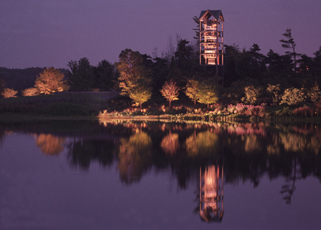
Photos from top to bottom:  (Evening Island at the Chicago Botanical Gardens) (Missouri Botanical Garden) (Colonial Williamsburg VA historic gardens) (Oakes 2011 Daylily Festival)  (Hollister House Garden, Washington CN).